Mark's Musings

A miscellany of thoughts and opinions from an unimportant small town politician and bit-part web developer

31 August 2026
by mark
0 comments

A better bank holiday

Unpopular opinion. Or possibly popular opinion. Making the last Monday in August a bank holiday was a bad idea.

August bank holiday is a bit of an oddity. Unlike every other bank holiday, its date isn’t based on a pre-existing celebration or holiday. It was just inserted into the calendar in 1871 by Liberal politician Sir John Lubbock, as he felt that the working classes deserved a day off in summer. Originally, it was the first Monday in August, but in response to pressure from the holiday industry it was moved to the end of August in 1965.

All of that is a bit anachronistic now. The holiday industry no longer gets a particular boost from a bank holiday. Changes in employment law mean that a bank holiday is much less significant to the working classes. A lot of businesses now operate on bank holidays anyway.

And even for those who do appreciate an official day off, the end of August is a bad time. Often, the weather is beginning to turn autumnal, with rain and wind. If it isn’t, then it’s often the opposite: stiflingly hot.

So, I think we should dump August bank holiday. I think a summer bank holiday is still a nice idea, but I’d move it to the last Monday in July. Put it at the start of the academic holiday rather than the end, at a time when, statistically, the weather is more likely to be dry and sunny. That would be a much better date for bank holiday events and festivals. And, unlike the current August bank holiday, there are several historical events whch could be celebrated at the end of July. The defeat of the Spanish Armada in 1588, for example. Or a “They Think It’s All Over Day” commemorating events at Wembley stadium in 1966. Although that might not go down so well in the Celtic fringes.

A downside of moving the summer bank holiday to July is that it then leaves an even longer gap until the next bank holiday at Christmas. Our bank holidays aren’t evenly distributed; we have three in the space of a week over Christmas and New Year, and then four over the space of a couple of months in April and May. And then one on its own in August, followed by a lengthy wait for the next.

I’d address that by having an autumn bank holiday. There are several possible options, all with strong external justification. Trafalgar Day in October is one that’s commonly mooted, but an Armistice Day bank holiday in November would make a lot of sense. Or even a “Democracy Day” on the 5th November. Or, in all of those cases, the nearest Monday if a midweek bank holiday is felt undesirable.

Adding an extra bank holiday to the calendar might not be popular with the government and industry. If so, then the alternative would be to move one of the May bank holidays to autumn. Personally, I’d shift the early May holiday; it’s often very close to Easter anyway and the weather is often not yet good enough for many open air events. Late May bank holiday is typically better from a recreational perspective (and it coincides with the school half term break), so I’d leave that in place.

Making these changes would give us a better summer bank holiday, and a better spread of bank holidays through the year. What’s not to like?

Incidentally, in support of the hypothesis that a late July bank holiday would typically have better weather than late August, I had a look at the historical flood alert archive at River Levels UK. Although most flooding happens in winter, there are still occasional downpours in summer. And August has typically twice as many flood alerts as July. Particularly towards the end of August as the weather starts to turn. This year, for example, we’ve had 107 flood alerts or warnings in England in August, compared to just 13 in July and 23 in June. That’s partly because of the heatwave and drought, of course, the disparity isn’t usually that great. But the pattern is consistent.
15 August 2026
by mark
0 comments

1976 and all that

There have been a lot of comparisons on social media with the drought of 1976. And there also seems to be a common topic of people denying that climate change is a factor in the current heatwave, as well as claiming that the health alerts (and, recently wildfire warnings) issued by the government are excessive because “we managed OK in 1976”.

Well, I do remember 1976, and yes, I did manage OK. But I’ve also taken the time to check over the actual data and news reports from the time rather than relying on my memory. I would suggest that anyone else of my generation recalling 1976 with rose tinted spectacles does the same.

So, some actual comparisons. The drought in 1976 was worse than this year. Much worse. It started earlier, and came off the back of an unusually dry preceding winter and autumn. So water levels started low, and got lower. This year, we had a fairly normal winter, and June was actually a bit wetter than normal. This year’s drought really only started in July. Although that’s had a completely different effect that wasn’t present in 1976. I’ll get to that later.

Also, while privatised water companies are everyone’s favourite villain at the moment, the reality is that our water infrastructure is much better than it was in 1976 – due, in part, to significant investment in the water network in the decades following 1976. We may complain about hosepipe bans now, but in 1976 there were some locations where you could turn on your tap and nothing would come out. Some rural villages had to be supplied by standpipes, people would take water carriers to the outlet and carry it back home – almost going back to concept of the village well. Meantime, the government ran advertising campaigns urging people to use less water – sharing a bath with a family member was one of the suggestions!

On the other hand, the heat wasn’t as severe in 1976. It was hotter than normal, and stayed hot for longer, but the maximum temperatures were significantly below this year’s highest. Despite that, there were significant health impacts. The heatwave was the cause of 20% excess deaths, and saw a significant increase in hospital admissions. If Met Office health alerts had been a thing back then, they’d have been issued on several occasions during that summer.

1976 also saw several major forest and heathland fires, particularly across southern England. Unlike this time, though, there was little direct effect on human habitation. One of the big differences this year is that our wetter than average June – unlike the dry June 50 years ago – encouraged plant growth. But those overgrown plants have subsequently dried out and become a tinderbox. Which is why this year is now the record year for wildfires, and there’s no sign of an end to it yet.

The biggest difference between then and now, though, is that a heatwave and drought is no longer rare. When it happened in 1976, it was the first time in living memory. We didn’t get another equivalent drought until 1995 – which was actually drier than 1976, although, oddly enough, we don’t really remember it now. The work to improve the water infrastructure after 1976 had done its job by then, so although 1995 was drier from a meteorological perspective it had less effect on everyday life.

But since then, we’ve had major heatwaves in 1997, 2003, 2006, 2022 and now 2026. A once in a lifetime event has become once every few years. And that’s the real evidence of climate change. The weather varies from year to year, we get wet summers, dry summers, warm summers, cool summers, and everything in between. But the warm summers are getting warmer. And the record breaking summers are happening more often.

So just because “we managed OK” in 1976 doesn’t mean we can ignore what’s happening now. There are some lessons we need to start learning, very quickly.

20 July 2026
by mark
0 comments

Torpenhow Hill – so hilly they named it once

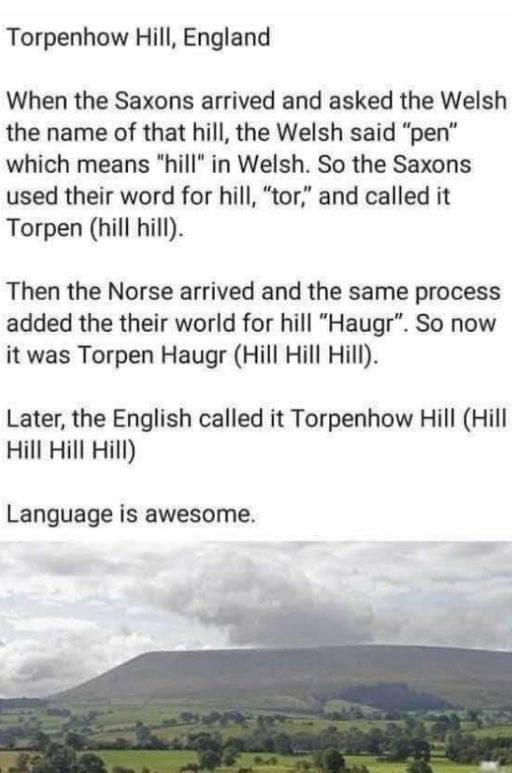
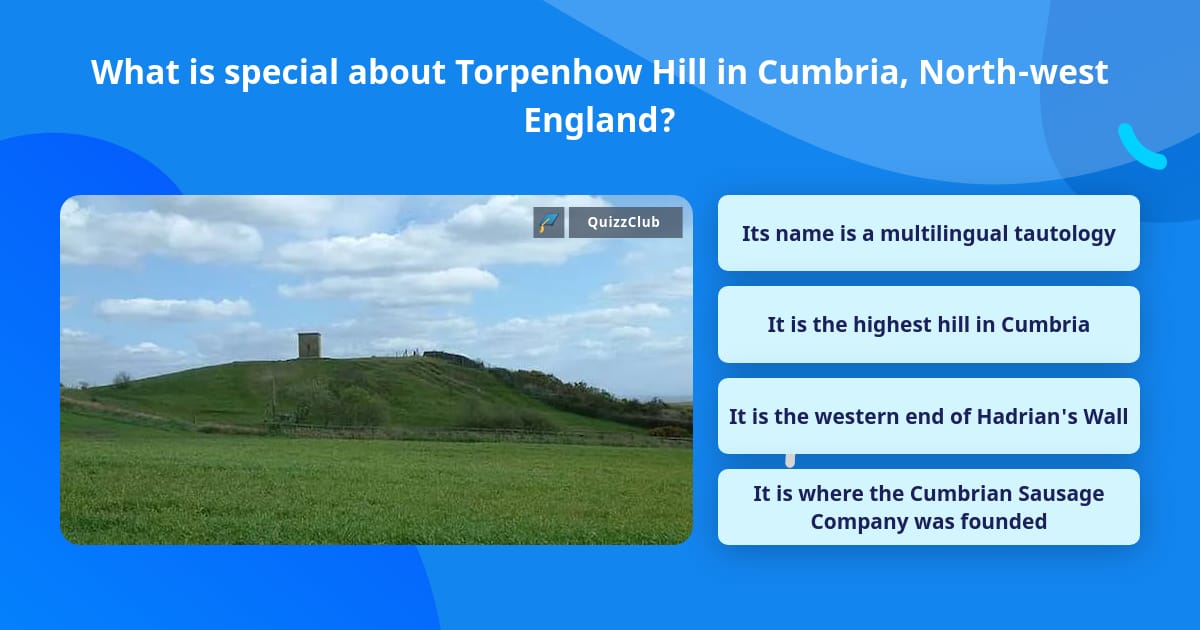
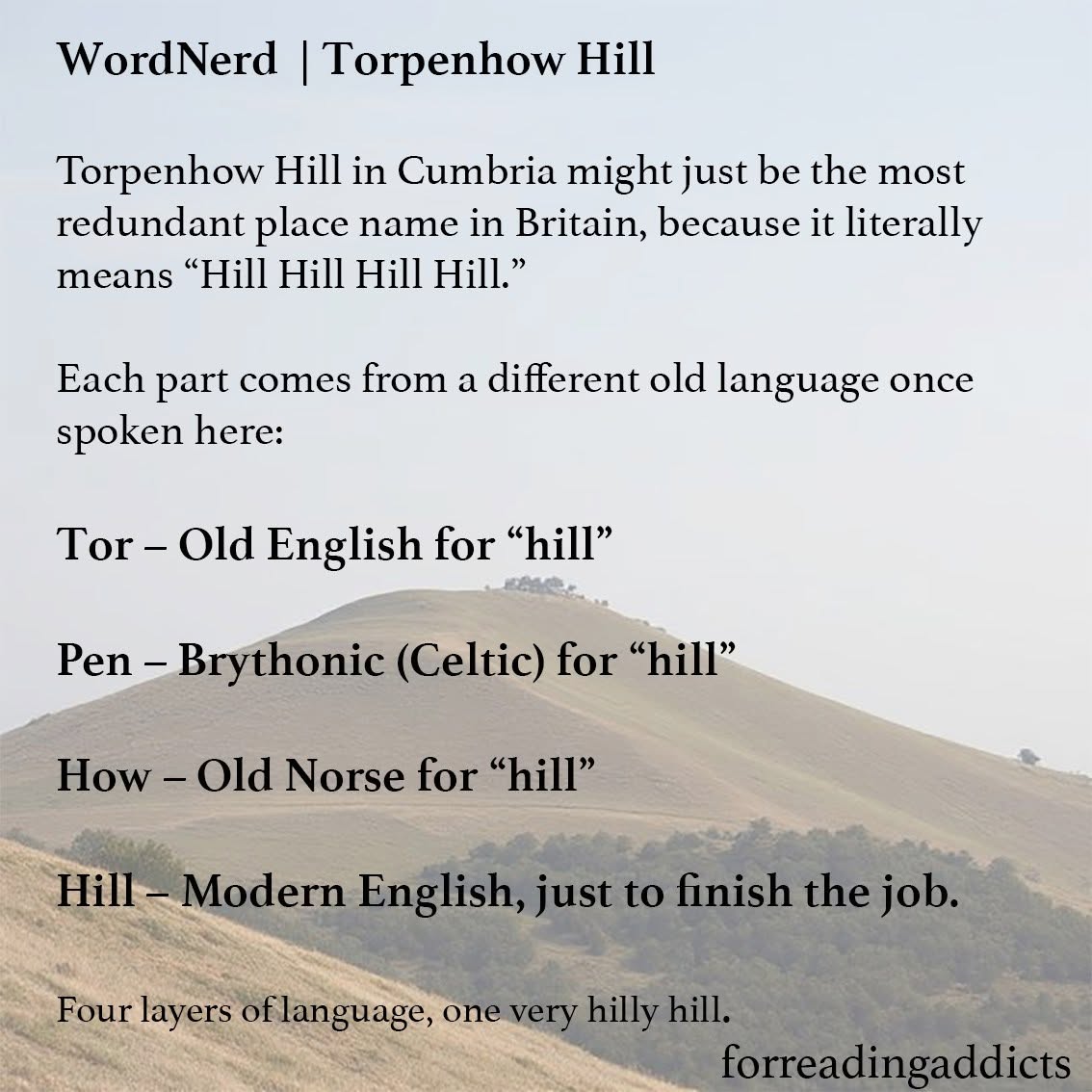
In any online discussion about tautological geographical names (such as River Avon, which means “river river”, the Sahara Desert, which means “desert desert” or Bredon Hill, which means “hill hill hill”), someone will always pop up to mention Torpenhow Hill in Cumbria, which combines the words tor, pen, how and hill to make “hill hill hill hill”.

The only problem with that is that Torpenhow Hill doesn’t really exist. Or rather, there’s no evidence to support the claim that the name evolved over time in the way that generally gives rise to tautologous names. It’s a modern invention, and only exists because it’s been deliberately contrived. Unlike, for example, River Avon and Bredon Hill, which both genuinely arose over time as a result of the evolution of language.

In fact, there isn’t anywhere in the UK which has any historical record of being called Torpenhow Hill. There are a couple of villages called Torpenhow, but no Torpenhow Hill.

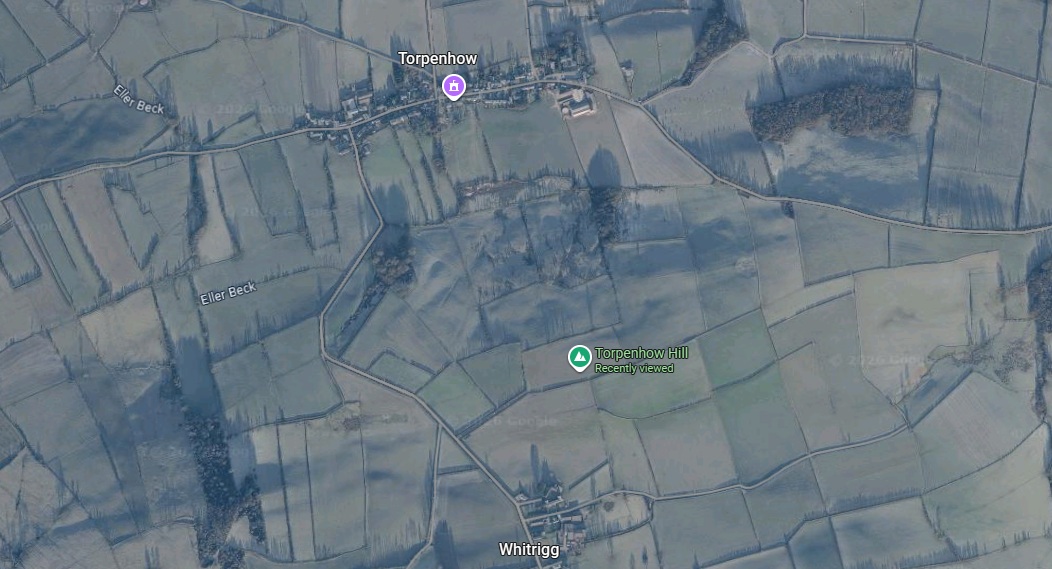
“Ah!” someone will, at this point, exclaim, and point me to Google Maps. Which, to be sure, has a place called “Torpenhow Hill”.

Torpenhow Hill on Google Maps

Unfortunately, that’s not particularly useful evidence, because Google Maps allows anyone to add names and edits to the map. And Google doesn’t apply any real quality control to user contributed data. I once got “Here be dragons” onto the map near where I live, and it stayed there until someone with possibly less sense of humour than me but almost certainly greater regard for accuracy renamed it to what it really is (a place on the River Avon – river river – where you can hire dragon pedalos).

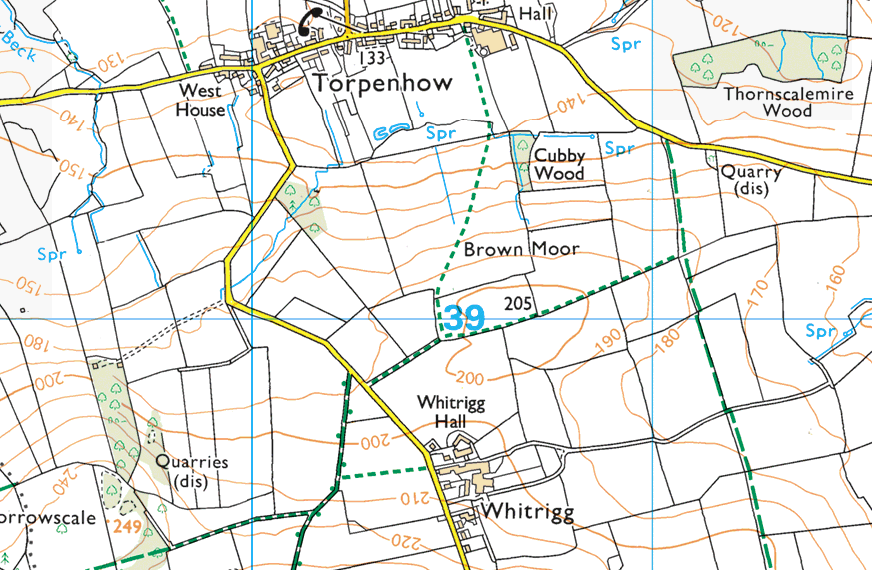
If we want a more reliable map, we have to look elsewhere. Ordnance Survey is the official British mapping agency, and their maps and map data is pretty much canonical. And OS has no record of Torpenhow Hill. Here’s the same part of the country (note the villages of Torpenhow and Whitrigg at the top and bottom respectively) on an OS map.

The area between Torpenhow and Whitrigg on OS maps

There’s also no entry for Torpenhow Hill in either Ordnance Survey OpenNames database, the Gazetteer of British Place Names, or the government’s Index of Place Names. It does appear in OpenStreetmap and Wikidata, but both of these are user-generated content (and the OSM entry relies on the Wikidata entry as its sole source).

Of course, if Torpenhow Hill did exist, there would be photos of it. And, indeed, on social media you will find photos of Torpenhow Hill. Except that they are not all photos of the same hill. This is a common one:

Not Torpenhow Hill

This is actually Pendle Hill.

Here’s another which has done the rounds of social media:

Not Torpenhow Hill

And this is actually Billinge Hill.

So maybe it’s this one:

Still not Torpenhow Hill

No, that’s High Wheeldon.

That’s the modern, readily accessible mapping evidence. But don’t take my word for it. The linguist Darryl Francis has done some extensive research, including checking various current and historical dictionaries of placenames. None of them mention Torpenhow Hill. I’m not going to quote all of his work here, but I will pull out a few relevant points.

The first is that the Oxford Dictionary of English Placenames has no entry for Torpenhow Hill. It does, though, have an entry for Torpenhow:

Torpenhow, Cumberland: The name contains the elements torr, ‘hill’, pen, ‘hill’ (Welsh pen), and Old English hoh, ‘ridge, spur of land’ or else (orr and Old Welsh pennou, the plural of pen, or torr and a name identical with Pinboe, Devonshire. In the first alternative the British name would have been Torr pen, to which was added Old English hoh. Torr pen would be analogous to Old Welsh tormeneth ‘top or breast of the hill’. The meaning would be about the same in the other alternatives.

So, while Torpenhow does have two words for hill in it (tor and pen), it’s still not really tautologous. The OEDP’s authors consider that the etymology is broadly equivalent to “top of the hill”, rather than “hill hill”. And, in particular, there’s no evidence for the assertion that the “how” in the name is from Scandinavian “haugr”.

Another relevant cite comes from The Placenames of Cumberland Part III, publish by Canbridge University Press in 1950:

Torpenhow Hall and church, which doubtless form the nucleus of the settlement, stand on a ‘rising topped hill ‘ which is itself on the northward slope of a long hill, and the name Torpenhow is doubtless descriptive of the site. The first element is the British torr, ‘ peak’, This would seem to have been compounded with British pen, Torpen then denoting ‘ peak-head’. To this was added in Anglian days the nglish hoh, giving forms Torpenho and the like. The old story, that the name bears witness to three successive races – British (Pen), Saxon (Tor), and Danish (How) – is incorrect: torr, though occasionally found in Old English, is really a loanword from British and torpen may well be pure British. The added how, to judge by earlier forms in -oc and -oh (ie Torpenoc, Torpenoh), would seem to be from English hoh rather than Old Norse haugr.

You can read the rest of Darryl Francis’s explanation of Torpenhow Hill here:

https://digitalcommons.butler.edu/cgi/viewcontent.cgi?article=4733&context=wordways

Or, in case that link to the original ever dies, I’ve put a copy here:

The Debunking of Torpenhow Hill

Nottingham University’s Key to English Place-Names concurs. In their records, the three elements of Torpenhow are

  • torr [Old English] A rock, a rocky outcrop, a rocky peak
  • penn [Primitive Welsh]
  • hōh (hoh) [Old English] A heel; a sharply projecting piece of ground

This illustrates another issue with the assertion that Torpenhow (Hill)  is a tautologous name. Genuinely tautologous names arise when newcomers to an area encounter a descriptive word in a different language to their own, and assume that it’s actually a name. So River Avon arose because speakers of more recent English didn’t realise that the ancient Brittonic word “avon” simply means “river”. And Bredon Hill follows the same pattern:

  • brey – Brittonic for “hill”
  • dūn – Old English for “hill”
  • hill – Middle and later English for “hill”

These are sequential, chronologically. Brittonic was extent from around the 6th century BC to the 6th century AD, give or take. Old English arose in the 5th century, and Middle English evolved under the influence of Norman French from 1066 onwards. It’s entirely understandable that each of these words could be interpreted by a subsequent non-speaker of the language as a proper noun rather than a description.

Torpenhow, though, doesn’t follow the same pattern. If we assume that the ODEP and KEPN are right about the etymology (and there is absolutely no evidence to suggest otherwise), then the three elements are Old English, Primitive Welsh (or Old Welsh), and then Old English again. And these are not three successive linguistic eras. Old Welsh was a neighbour, not an antecedent, of Old English. The authors of The Placenames of Cumberland (quoted above) make exactly the same point.

So however the name Torpenhow arose, it wasn’t caused by people misunderstanding an archaic (to them) language. Cumbria, though not part of Wales, was part of the Celtic influenced milieu of pre-Norman Britain. Whoever first glued the words “tor”, “penn” and “hoh” together to make Torpenhow knew what all three of those words meant. It wasn’t a tautology then. And it still isn’t.

20 July 2026
by mark
0 comments

Hey, Andy – how about some devolution over here?

As of this morning, we have a new Prime Minister. Although he’s from a different party to the one I represent, I genuinely wish Andy Burnham well. He’s taking office at a challenging time, and I hope he will live up to his promise to take a different approach to politics.

In particular, I hope that Burnham really means what he says when he talks about devolving power away from the centre. And I hope that by that, he means everywhere in this country, not just a few bungs to our friends in the north.

In 2024, the government, led by Burnham’s predecessor, imposed a massive increase in the housing target for Wychavon, almost doubling the number of properties we are expected to ensure are built. This year, because our planning officers and committee have had the temerity to refuse ever so slightly more applications than the government sees fit, developers have been given the option of bypassing our planning department and going straight to the planning inspectors for a decision.

Both of these are the complete antithesis of any commitment to devolution and localism.

Planning is always controversial, and there are going to be times when we do have to make decisions which are unpopular. It isn’t wrong to consider the needs and aspirations of future homeowners as well as those already on the housing ladder. Building for the next generation is a key part of our role in local government.

But these are decisions which are best taken by people who are fully familiar with all the local constraints and conditions. Our planning officers, who are specifically employed to assess applications and consider them in the context of our community. Our planning committee members, who act as the representatives of that community in the decision-making process.

If Andy Burnham really wants to put devolution into practice, then one of the best places to start would be the planning system. Put decision-making back into the hands of local communities. Allow communities to develop their own priorities, and let local circumstances play a key role on determining applications. If the government wants more houses built, then incentivise building by investing in critical infrastructure such as transport, education and healthcare rather than threatening communities with penalties for not building enough. Support the creation of strong, enforceable design codes which result in the kind of houses and streets that people actually want to live in.

Above all, make housing development community led, not numbers led. Anyone can sit at a desk in Whitehall and type figures into a spreadsheet. But only those who live and work in an area can put those figures into context.

So come on, Andy. Let’s see if you’re serious about real change.

22 January 2026
by mark
0 comments

Back to the roots of the web

In the early days of the web, every self-respecting website had a “links” page which listed other sites that the reader may find interesting. The phrase “surfing the web” came from the practice of starting with a website you already knew, then following the links page to discover new sites, and then following their links to other sites, and so on.

Links pages gradually lost their role in website discovery with the creation of directories, such as DMOZ and the original Yahoo, and then the rise in search engines such as AltaVista and Google. For a while in the early 21st century, social media networks such as MySpace, Twitter and the early Facebook were also key sources of website discovery.

It wasn’t long, though, before the social media networks started to make it harder to use them to discover websites. Monetisation means maximising user retention, and every click to an off-network website reduces their opportunity to put more adverts in front of eyeballs. So posts containing links are downgraded by the algorithms, and fewer people see them.

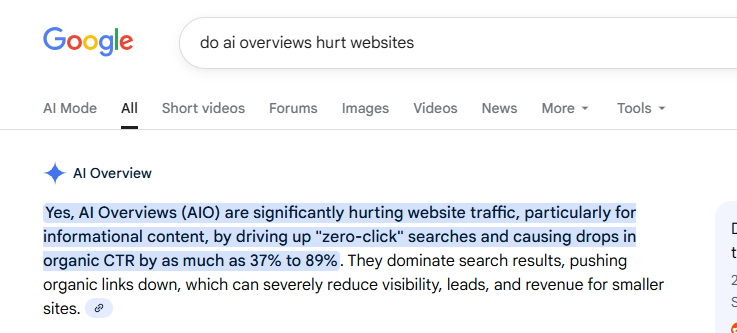
More recently, though, even the search engines have started to turn their backs on website discovery. The AI overviews at the top of most result pages pushes website links down the page and makes it much less likely that people will see them.

This is reducing visits to websites, as even Gooogle’s own AI agrees. In some cases, this may be no great loss. But it is a major blow to sites which rely on advertising to survive. And it also means that even official, authoritative sources of key information (such as the government, or your local council) are being downgraded in favour of unreliable AI summaries. People will accept an AI summary as gospel rather than checking the source, or looking to see what the media have to say.

So, with the loss of discovery traffic from social media, and now the loss of search engine traffic, how will independent websites survive?

A lot of them won’t, of course. But in the long run, I have a feeling we’re going to see the independent web going back to its roots. Websites linking to each other. Maybe even the return of webrings! And possibly the reinvention of web search by new entrants into the market. The web ecosystem and the social media/AI ecosystems will diverge. And maybe, just maybe, in the long run the web will be better for it.

31 October 2025
by mark
0 comments

Seasons – a Spotify playlist

Edit: I’ve put this on the resurrected Friday Fun website. You can find it here:

https://fridayfun.net/playlists


Apparently, the majority of music radio listeners these days prefer stations which focus more on “classic” tracks from the past rather than current chart hits. I have to admit that I fall into that category as well; the majority of my radio listening is to Absolute Radio or Greatest Hits Radio (and occasionally Kiss and Planet Rock) rather than stations playing contemporary hits.

One thing that’s always irritated me slightly, though, about “gold” format radio is that it tends to play tracks out of context. In reality, popular music follows a discernible pattern through the year; there’s a noticable difference between the types of songs that are popular in summer and those that are popular in winter. Not necessarily every song, of course, but enough for it to make a difference. Apart from mid to late December, though, when the “gold” stations go all-out, and often excessively, festive on their playlists, you don’t get a sense of that when listening to them.

So, I thought I’d see if I could come up with something which fills that gap. I’ve created an algorithmically generated Spotify playlist which includes a selection of songs which would have been on contemporary music radio playlists at this time of year.

Basically, how it works is that it looks for songs which were either in the charts or were, at the time, recent new releases on this day in past years – that is, the sort of songs that would have been  on contemporary music playlists at the time. It then assigns each song a weighting based on a number of factors.

For example, songs get uprated for being new releases, new entries, big risers or number ones, and downrated for being fallers or for having lingered a long time in the chart. It also adds a small amount of random jitter so successive days aren’t identical, even though they’ll be based on very similar dates.

It then picks the hundred with the highest daily rating, and updates the playlist accordingly.

A hundred songs is approximately six hours listening, so if you feel like it you can listen to this most of the day and you should only hear each song once.

I’ve called it “Seasons” because the idea is that it will change with the seasons as you listen to it over the course of a year.

This is very experimental, and I’ve love feedback on how well you think this works. One of the obvious downsides is that it does result in a wildly varying mix of genres and eras. You could find yourself going from Metallica to Taylor Swift to Elvis Presley in the space of a few songs.  Plus, of course, at Christmas you will get St Winifred’s School Choir alongside Slade and Joe Dolce alongside Ultravox. And numerous tediously unmemorable X-Factor winners.

But then, that’s a bit like the radio would have been at the time, so there is at least a hint of authenticity there. I am excluding a small number of artists with convictions for certain criminal offences – you can probably guess which ones I mean – but other than that, I’m not applying any editorial control.

Anyway, here’s the playlist as an embed in this page. If you prefer to go directly to it on the Spotify website, or open it in the app, the link is underneath. And please, let me know what you think in the comments.


Direct link: https://open.spotify.com/playlist/7eeRB8ZvkaLrRdQpFYOS43?si=PpKfu2P6RP2eTnPLl6WWrw

4 December 2024
by mark
0 comments

Whamageddon-out-of-here

I will not be participating in Whamageddon this year.

My reasons for this are many and varied. But, basically, I think it’s time to call it a day. It was a fun game for a while. But I get the feeling that some people are taking it a bit too seriously. And, as the saying goes, when the fun stops, stop. If you’re reached the point where being Whamageddoned would cause you actual distress, then get it out of your system now. Pop over to YouTube or Spotify and feast your ears on a classic 1980s Christmas hit and realise that you’re better off hearing it than avoiding it.

And it is, after all a great song. The Wham era of George Michael’s career is often dismissed as a mere stepping stone on the way to his solo work. But, actually, it produced some really catchy pop tunes, and Last Christmas is one of the best. Had it been released in any other year, it would definitely have been the Christmas number one.

The reason it wasn’t the 1984 Christmas number one is, of course, because that year it came up against Band Aid and the charity single which kicked it all off. It did finally reach number one in 2022, but until then it was, without a doubt, one of the greatest songs to have peaked at number two (along with Vienna and Fairytale of New York).

What’s possibly less well known is that, when the Band Aid project was announced, Wham decided that they, too, would donate the royalties from their Christmas single to Ethiopian famine relief. Given that Last Christmas was easily Wham’s best-selling single, that was a significant act of generosity. And, in retrospect, Last Christmas has stood the test of time rather better than Do They Know It’s Christmas.

So, stop trying to avoid it. Listen to the song, enjoy the song and celebrate Christmas via a slice of musical nostalgia without guilt or embarrassment.

18 October 2024
by mark
0 comments

Why the web is getting worse

Have you noticed that websites are increasingly plastered with more and more adverts these days?

Have you wondered why that is? Are you maybe blaming greedy website operators, just as you check out the latest ad-blocker extension for your browser?

If so, you’re right that the trend is towards more and more adverts. But you’re probably wrong in thinking it’s all about greed on the part of the website publishers.

In reality, this is an unintended consequence of something that is supposed to be a good thing.

Online privacy has become a significant concern. In particular, the ability of advertisers and publishers to track your behaviour across multiple websites is something that many people are uncomfortable with.

Both legislators and browser manufacturers have responded to this. The cookie consent laws requiring you to explicitly consent to marketing cookies, alongside browser enhancements such as “do not track” features and default blocking of third-party cookies, have made it much, much harder for advertisers to track people across multiple websites.

So, this is a good thing, right?

Well, maybe. It does address issues around privacy on the web. But it also changes the online advertising landscape considerably.

There are, essentially, two main ways of paying for online advertising: “pay per click”, where the advertiser only pays if someone actually clicks on an advert and visits their website, and “pay per view”, where the advertiser pays simply to put their advert in front of as many people as possible – the digital equivalent of print, radio or TV advertising. For historic reasons, these methods are known within the industry as CPC (which stands for “cost per click”, as seen from the advertisers perspective) and CPM (which stands for “cost per thousand”, as applied to views – the M stands for “mille”, which is Latin for a thousand).

CPC (pay per click) has, since the early 2000s, been the preferred method of online advertising. It works well for both advertisers and publishers. Advertisers like it because they only pay for adverts which actually work – they pay nothing for adverts that get ignored. Which means that none of their advertising spend is wasted, which in turn makes them willing to spend more on them. And publishers like it, because of the higher prices paid by advertisers. It’s a win-win.

The downside, for consumers, is that CPC relies on tracking. The advertiser has to know which of their adverts has been clicked on, so that they can only pay for that advert shown to that visitor. And that needs tracking cookies.

But tracking cookies are now everybody’s favourite villain, hence their discouragement by both legislation and technology.

A consequence of that is that the main advertising networks, such as Google Adsense, have mostly switched away from CPC and now use primarily CPM (pay per view) adverts. Here’s a graph which illustrates that very well:

That’s a graph of my business’s advertising revenue over the past three years. The blue line is CPC (pay per click) revenue. The red line is CPM (pay per view) revenue.

What you can clearly see is that, earlier this year, revenue flipped almost completely between CPC and CPM. And that’s not just for me, it will have happened to almost all publishers.

For you, the consumer, that may seem a good thing. You’re no longer being tracked all the way around the world by advertisers. You’re just being shown adverts, which you can ignore if you want to, just as you can in a newspaper.

But it’s not particularly good news for publishers. You can see that the red line on the right is mostly lower than the blue line on the left. That means that advertising revenue is down. Again, that’s not just for my business, it’s across the board.

That’s one of the reasons why you’re increasingly being nagged to sign up for a paid-for subscription when you view certain websites. If you visit The Guardian, for example, you’ll be confronted by a massive overlay banner pleading with you to sign up for a monthly payment. Over at The Telegraph, you’ll find that a lot of content is now behind a paywall. And The Times went fully paywalled a few years ago, something which seemed like a dubious move at the time but has now been vindicated.

But there’s another consequence for website visitors, too.

In the days of tracked CPC advertising, having a lot of adverts on a web page wasn’t always helpful. In fact, the opposite was often more true. If you had two potential adverts to show, one of which would pay you, say, 50p for a click and the other only 25p for a click, then it could make sense to  only show the higher priced one. And there was no point at all showing adverts that nobody was ever going to click on. The best solution was almost always a small number of highly-targetted, high-paying adverts.

Without tracking, though, there’s no targetting and no high-paying CPC adverts. And if a publisher is getting, say, a tenth of a penny  for a single CPM advert, then the best way to bump that up is to show half a dozen CPM adverts. Even better, show the adverts that advertisers do pay more for, such as video ads.

So what’s happening is that website visitors are increasingly confronted with websites that are smothered in adverts. Because, often, that’s the only way to maintain revenue at previous levels. And it’s also why many smaller advertising-supported websites, that don’t have the resources to implement a paywall, are in danger of dropping off the web altogether.

I don’t think that’s a good thing. I understand the concerns of privacy activists, but I also think that the response to those concerns has created a situation which, for most people, is worse.

My preferred solution would be to repeal the cookie laws. Get rid of the annoying coookie consent popups. Allow advertisers to go back to tracked and targetted CPC advertising.

Most people would, I think, prefer that to the current situation where their favourite websites are disrupted by intrusive and excessive advertising. And it’s still easy enough to avoid being tracked if you want to. Use an ad-blocker, or your browser’s “incognito” mode. Both of those damage ad revenue to a degree, but not as much as the loss of CPC.

I don’t object to people using an ad-blocker when they visit my websites, if that’s what they want to do. I do object to them not being able to choose to accept targetted advertising because they know that supports the site’s operation.

The cookie legislation was supposed to give consumers more choice. What it’s actually doing is taking choice away, and degrading their web viewing experience as a consequence. And that is most definitely not a good thing.

11 September 2023
by mark
0 comments

Accession Memories

A year ago today, I stood on a dias in the market square to officially proclaim the accession of a new King to the people of Evesham. Of all the things I’ve ever done as part of my civic duties, this is, I think, the one that will always be the strongest memory.

Photo: Emma Haynes

It all started, of course, a few days earlier, when the Queen was reported to be in bad health and her family were heading to Bamoral to be by her side. Nobody in the media was so crass as to say so, but in the background we already knew it was a case of when, not if. A set of black table clothes, condolence books and official photos had been delivered to the town council office in preparation.

What made it more complicated, from our perspective, was that the town clerk was away on holiday – and on a cruise, so she couldn’t just cancel it and come home! So I had little choice but to take the lead myself in making the necessary arrangements, with the sterling assistance of Julie, our newest member of staff.

When the official announcement actually came I was just about to sit down with the family to eat our usual “Pasta Thursday” evening meal. I grabbed my plate, took it with me into the study where I switched the council website into “Operation Royal Bridge” mode and made a series of announcements on social media, then hot-footed it to the town flagpole to lower the flag to half mast.

The following morning, Julie and I finalised the arrangements for the books of condolence, and then started to plan for the Accession proclamation. We decided we’d make it as formal an occasion as possible, with the councillors in their ceremonial robes and Avonbank brass band to play the national anthem. At the last minute, I decided that we ought to have a microphone and speakers so that if the square was full, those at the back would be able to hear. Fortunately, Nick Kilby was willing and able to step in at very short notice.

When I arrived at the town hall on Sunday afternoon, I was, to be honest, mildly annoyed that everything had already been set up with the dias in front of the scaffolding on Nat West Bank. It didn’t strike me as being the best setting for something so momentous. I’d planned to put the dias under the tree instead. But changing it would have meant changing everything else around, so I decided to go with it. We did take two of the union flags from the town hall (a leftover from the jubilee) and tied them to the scaffolding to try to give it a slightly more formal appearance.

I’d had two documents emailed to me from the office of the High Sheriff of Worcestershire: the proclamation itself and the framework of a brief preamble that merely needed to be localised for Evesham in place of generics. I’d also written a short speech to go after the proclamation.

Earlier that day, I’d watched my colleage Alex Sinton, chairman of Wychavon District Council, struggle a bit with reading the proclamation from an A3 sized scroll, which was difficult to keep open in the right place. Given that I had to print the proclamation myself, I’d decided that I wouldn’t try to make it look like a scroll, I’d just use a sheet of A4 paper. But I wanted to add a bit of theatre to the occasion, and in particular I wanted it to be clear, visually, when I was reading the proclamation and when I was reading my own words. So on the Saturday, I’d popped into The Works and bought a purple ring binder and some loose leaf holders. One holder contained the proclamation, which was clipped into the binder. The other contained the preamble and my speech, back to back, but remained loose.

When I stepped onto the podium, I carried the binder containing the proclamation with the other leaf held against the front. That way, I could read the preamble with the binder closed beneath it, then, in order to read the proclamation I opened the binder. And at the end of the proclamation, I closed the binder and turned over the loose leaf to have my speech uppermost. Normally, I’m quite comfortable winging it when speaking in public, but in this case I rehearsed reading it all through several times at home first. Given the somewhat archaic language of the proclamation, I wanted to be sure I didn’t trip over any of the words.

In retrospect, having the podium in front of the bank was the right choice, despite the scaffolding. The square was absolutely packed by the time we started; if I’d been under the tree then half of the people would have been behind me. It’s not the biggest audience I’ve had for a speech – that would be at the Battle of Evesham Festival – but I’m certain it was the loudest and most sustained round of applause at the end. Not that that was particularly for me. Everyone there was well aware that they, too, were participating in history in the making, and the applause was for the Accession, not the proclaimer.

I hope everyone went away from the square with their own indelible memories of the day. I’m just incredibly proud to have had the immense privilege of playing a key role in it.  And incredibly grateful to everyone involved who worked so hard to pull it all off.


Here are the three documents from that day: