Mark's Musings

A miscellany of thoughts and opinions from an unimportant small town politician and bit-part web developer

25 July 2022
by mark
0 comments

Britain’s next Prime Minister

Over the course of August, members of the Conservative Party will vote to elect the next Prime Minister of the UK.

That’s a big responsibility, and one which I hope my fellow party members will take seriously. In particular, I hope that all of us will remember that we are not just electing a leader of the party, but we are electing a Prime Minister.

That means, first and foremost, that the person we elect has to be someone who is up to the task. They must have demonstrated a high level of competance in their career so far, both political and commercial. They must have a high level of personal integrity. And they must be someone who has the ability to unite the party, and reach out to floating voters.

Both the candidates we are choosing from have their qualities. But I believe that one of them is, very clearly, the better of the two. And that is the person who will get my vote.

That person is Rishi Sunak.

Why?

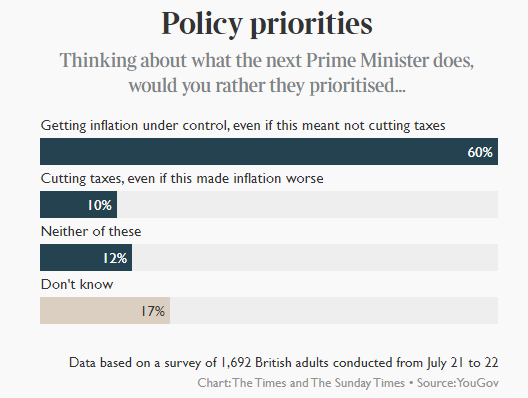
I believe that Sunak is the better candidate, for a number of reasons. Firstly, he isn’t trying to buy our votes with pork barrel promises of unfunded tax cuts. And this is something that the general public – the voting public – clearly agrees with. In a survey reported in today’s Times, 60% of the public think that reducing inflation is more important than cutting taxes. Only 10% thought the opposite. Sunak is the only candidate who has consistently made tackling inflation his priority. On this, he is on the side of the people.

Opinion polls repeatedly show that, among the electorate at large, Sunak is perceived as the better candidate and the one more likely to persuade them to vote Conservative at the next election. If winning elections matters to us, then those opinions should matter to us, as well.

Secondly, Sunak has demonstrated his ability to think on his feet and respond fast. Thrown in at the deep end as Chancellor when Sajid Javid resigned in early 2020, Sunak was immediately in the forefront of Britain’s response to the Covid pandemic. His furlough scheme – much more innovative and flexible than similar projects elsewhere – helped ensure that financial losses to businesses and their employees were minimised. There’s no doubt that, without it, a very large number of companies would have gone to the wall and their workers would be out of jobs.

Sunak’s personal wealth has come in for some criticism, but the reality is that he’s earned it. Born into a middle class, immigrant family, he worked and studied hard for his deserved success in the financial sector – another reason why I trust him to make the right decisions on taxation. There’s no room for the politics of envy here. And one thing we can be sure of is that if Rishi wants to redecorate 10 Downing Street, he’ll pay for it himself!

Don’t just take my word for it. Former Conservative leader and Foreign Scretary William Hague was Sunak’s predecessor in the constitency of Richmond, Yorkshire. If you can get through the paywall, Hague’s article in The Times is a must read. But I’ll quote the key section here:

I represented Richmond in the Commons for 26 years until 2015, and I will never forget the scene when hundreds of local worthies assembled to choose my successor as the Tory candidate. “A farmer would be good, or a military man,” some of them said on the way in. “We need a local candidate,” said others, or: “Obviously they have to come from Yorkshire, that’s a given.”

Military men and strong local figures were all available to them. But when they filed out three hours later, they had chosen someone new to farming issues, with no army career, who wasn’t local, not from Yorkshire and was from an ethnic minority and brought up in Southampton. They were stunned but thrilled. They had chosen Rishi Sunak.

At the election that followed, local independents and Ukip fancied their chances against this newcomer. But they were all routed by Sunak, who turned out to be a highly energetic, bright, emotionally intelligent candidate.

We need someone who is energetic. We need someone who is bright. And we need someone who is emotionally intelligent. Of the candidates we have in front of us, Sunak ticks all of those boxes.

It matters, too, that Sunak is the preferred choice of our MPs. I do think it’s good that the party membership has the final say in our leader. But we need to be cautious about exercising that responsibility. We’ve already seen what happened to Labour when members installed Jeremy Corbyn despite their MPs wanting someone else. It’s happened to us, too. Iain Duncan Smith was the choice of the members, against the wishes of our MPs, and in retrospect that didn’t work out too well either.

If we were currently in opposition, then I’d be more relaxed about disregarding our MPs’ wishes. Sometimes you need a new broom to rebuild from the ground up. But in government, we need someone who is able to work with the people already there. It’s not the only consideration, of course. But we owe it to our MPs to take their opinion seriously here. Our MPs have the advantage of seeing the candidates close up in their day to day work, and can see how well they’ve been doing their jobs. Let’s work with them, not against them. Sunak is the Parliamentary choice, and should be the members’ choice, too.

Finally, there will, unfortunately, be an element of prejudice among those who would rather have a white face in Downing Street, and a more understandable fear that prejudice may harm our electoral prospects. But in an era when our main Parliamentary opponents have never had a leader who is anything other than white, male and British, the Conservatives have already given the UK our first ethnic minority Prime Minister (Benjamin Disraeli), our first immigrant Prime Minister (Andrew Bonar Law) and our first female Prime Minister (Margaret Thatcher). It would be entirely fitting, and completely in accord with Conservative principles, if we give the UK its first non-white Prime Minister.

Rishi Sunak has the ability, the experience, the backing of MPs, the appeal to the electorate, and offers us once again the opportunity to make history. I’ll be voting for Rishi. I hope you will, too.
22 June 2021
by mark
0 comments

How many years of hurt?

Over on the Facebook “World Cup of Things” group we recently decided that “Three Lions” is the Greatest Football Song Of All Time. Which it undoubtedly is.

But one thing has always irked me about it. The original version, released in the run-up to Euro 96[1], goes on about “thirty years of hurt”. But it’s not thirty years.

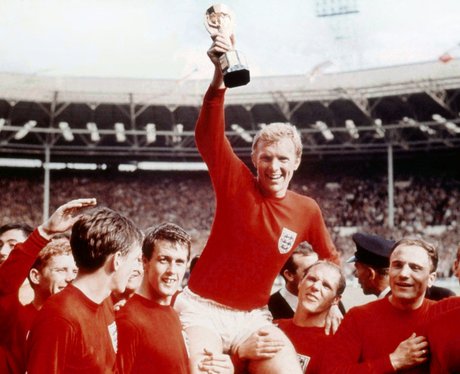
To be sure, 1996 was thirty years after we last won the World Cup. But for the first four of those thirty, we were the reigning world champions. There’s nothing hurtful about that. The hurt couldn’t possibly have started until we were eliminated from the 1970 finals.

But even then, I’m not sure it was really that hurtful. OK, we lost to Germany, which is always unpleasant. But, realistically, England were not the favourites for that tournament, and none but the most churlish of English football fans could possibly begrudge the eventual winners, Brazil – especially after that Carlos Alberto goal, which is still the Best Goal Ever Scored In A World Cup Final.

So you can put 1970 down as a blip. Won one, lost one, back next time.

Except that next time didn’t come. Or, rather, we didn’t come the next time. In 1974, we suffered the ignominy of not even qualifying for the finals – just eight years after winning the thing, we were out in the wilderness.

And that, I’d argue is when the hurt really started. And it carried on hurting in 1978, when we once again failed to qualify (and Scotland rubbed it in with Archie Gemmill’s glorious goal against the Netherlands). Even though we got back in in 1982, and haven’t missed out since, we still haven’t erased those memories of being on the sidelines.

So, in 1996 it wasn’t thirty years of hurt. It wasn’t really even 26 years of hurt. It was 22 years of hurt. And now at Euro 2020(+1) it’s 47 years of hurt. But none of them work as well in a song as thirty. So once again, poetic licence overrules reality.

[1] Football wasn’t Y2K compliant in 1996.

21 November 2020
by mark
0 comments

Fury-tale of New York

There’s been a fairly predictable response in some circles to the news that Radio 1 will, this year, be playing an edited version of “Fairytale of New York” that cuts out some of the more potentially offensive words.

In particular, the debate revolves around the word “faggot”, which, while not a homophobic slur in the context of the song, is now widely perceived as one. Some people think that it’s wrong to use the word at all, because of its connotations to a 21st century audience, while others are equally firm that the only meaning that matters is the meaning it had when written.

For what it’s worth, I think the whole argument is overblown. Lots of songs are edited for radio airplay, and the decision on what to edit changes over time. Try listening to the uncensored version of most Eminem songs, for example, if you think that radio edits are a bad thing. Or, for that matter, the original wording of “The Sun Has Got His Hat On”. But, on the other hand, radio stations now play “Relax” by Frankie Goes to Hollywood, despite it originally being banned by the BBC. “When I’m Cleaning Windows”, by George Formby, was once considered too obscene to broadcast.

Radio 1 is perfectly entitled to decide which version of any song, “Fairytale of New York” included, that it wants to play. Other radio stations are equally entitled to make a different choice. It seems to me that the BBC’s decision to treat the song differently on Radio 1 and Radio 2 is sensible. Radio 2’s audience is, typically, more mature and will mostly have grown up with the song in its original context. Radio 1’s listeners mostly don’t have that cultural background, and it’s unreasonable to expect them to have to take a history and etymology lesson before they can enjoy the song.

Personally, I prefer the original. But then, I’m of an age to remember the original, and recall that the word in the lyrics whch was most contentious back then was “arse”. The Top of the Pops version of the song from 1987 keeps “faggot” but changes the line “Happy Christmas your arse” to “Happy Christmas you ass” – although Kirsty McColl cheekily references the original line by slapping her backside when singing it.

These days, nobody has a problem with “arse”, but a lot of people have a problem with “faggot”. The perceived offensiveness of words is very much a cultural thing, and there’s no reason why Radio 1 shouldn’t attempt to reflect the culture of its current audience. In another twenty years’ time, maybe that position will have reversed again. My only hope is that, sometime in the next few years, society will develop a strong aversion to some of the language used in any Christmas single by Paul McCartney and radio stations have to stop playing them altogether. Now that would be a culture war worth winning.

16 November 2020
by mark
0 comments

Pay as you go for a drive

The Treasury has, reportedly, been considering the possibility of introducing pay-as-you-go road pricing to replace the revenue which will be lost from fuel duty as the UK transitions to electric cars.

This isn’t particularly surprising, and similar ideas have been floated for many years. But, obviously, now that we are commited to phasing out petrol and diesel vehicles, it’s become a much more pressing issue.

As a general principle, I don’t object to this. I think that the idea of road users being taxed according to their usage of the roads makes sense, and usage payments have the potential to be fairer than fuel duty. But there are couple of important caveats.

The first is that it has to be more nuanced than a simple per-mile charge. Charging by distance discriminates against rural users, who often have no choice but to use cars and have to drive them over longer distances. And rural users of uncongested roads are contributing significantly less to air pollution and accident statistics. These facts need to be reflected in the charging regime. Someone driving ten miles from a rual village to their nearest town should not pay more than someone driving five miles to work in a major city.

The second is that any scheme should encourage both the government and road users to keep roads flowing freely. And this is more complex than it sounds.

One often-floated suggestion for road pricing is that people should be charged more for driving on roads that are more congested. There is some logic to this, because it would tend to encourage people to spread out their journeys and make them at less busy times. But, on the other hand, it would create a perverse incentive for the government to artificially inflate road pricing revenue by starving the transport network of funding and forcing more and more people to use congested roads. And it would also unfairly discriminate against people who find themselves in a traffic jam through no fault of their own – for example, when a road is blocked by an accident or roadworks.

A successful, and politically acceptable, road pricing scheme, therefore, needs to be contstructed in such a way that both road users and the Treasury benefit most from well-maintained, free-flowing roads.

That’s harder than it sounds, and there will inevitably need to be some compromises along the way. But working out this detail is important if this proposal isn’t to end up a political millstone for whichever future government implements it.

10 July 2020
by mark
0 comments

The curious case of “Fairfield Road”, Ealing

For those in the open data community, the recent release of Unique Street Reference Numbers (USRNs) and Unique Property Reference Numbers (UPRN) coordinates as open data has been welcome (and something that I’ve been lobbying for previously). However, the information released as open data is, to say the least, limited.

Essentially, the open data releases allow us to link UPRNs and USRNs to geographic coordinates. There are also some lookups supplied by Ornance Survey to allow UPRNs (properties) to be linked to the nearest USRNs (streets), as well as some other OS open data.

However, none of this contains any names or addreses. That’s not surprising, because OS makes a lot of money selling address data, and they don’t want to lose that revenue stream. However, it does mean that the open UPRN and USRN data isn’t as useful as it might be.

However, it is still valuable, and there have been discussions on the Open Streetmap mailing list about how best to use it in OSM. In particular, one contributor, Kai Poppe posed a question about an unnamed street in Ealing (the one in the middle of the map at the top of this page). In summary, the question was whether the open data might help us name that street.

I decided to look into it, since I’ve been experimenting with the open USRN and UPRN data as well, and linking names to numbers is one of the things I’ve been working on. My full reply to Kai is here, but this is an extract:

To find the USRN of the path, you need to use the lookup tables supplied by OS. Doing that, we find that the associated USRN is 20602512.

Now, there’s no open data source which will directly tell you the name of a USRN (at least, not until we start putting them into OSM). The long way of doing so is to find the matching LineString in OS OpenMap Local, and see what name it has there.

However, it can be done directly via a non-open source. If you go to https://www.findmystreet.co.uk/map and zoom in on the location, then click the street to bring up the USRN details, it will give the name (and also confirm that the USRN from the OS lookup table is correct). Or use the search box and search for USRN 20602512.

From an OSM point of view, that would normally be a dead end. Even if you can view the information on a non-open source, you can’t incorporate it into OSM. However, in this case, we already have an abbreviated name from an open source. So all we are learning from the closed source is the full text of the abbreviation. Whether that makes it acceptable to include the full name into OSM is a matter of debate. I’ll leave that decision up to others, but, for reference, the name of the street is Fairfield Road.

However, I’ve been doing a bit more research in this, as it piqued my interest. And the results are a little surprising.

For a start, USRN 20602512 doesn’t match Fairfield Road in OS LocalMap Open. In fact, there’s no Fairfield Road anywhere near there in OS LocalMap. Matching the coordinates indicates that, as far as OS is concerned, it’s a part of Southdown Avenue. That’s not particularly unusual, access roads off named streets often don’t have a name of their own, they’re either completely unnamed or share the name of their parent street.

However, I did wonder whether this might just be a limitation on OS Open Data, and whether OS MasterMap (the primary mapping product of OS) might actually include the name. That’s not reusable in OSM, or any other public website without paying a hefty licence fee, of course, but it might help point to an open source that does contain it.

But it seems that even MasterMap doesn’t have that name. You can check that by looking at Ealing’s online GIS website:

http://maps.ealing.gov.uk/Webreports/Planning/Planning.html

This is a planning application map, but it’s just a window into their GIS system and you can turn off the planning layers. Anyway, zoom all the way in to the street in question – I can’t give you a persistent link, but it’s just above the LA boundary in the bottom middle of the map – and… it still has no name. At the highest zoom level, this is MasterMap, and every named object has its name displayed. But there’s no name here.

Google, also, knows nothing of a Fairfield Road here. Using the Maps API to query the coordinates of USRN 20602512, we either get Southdown Avenue, again, or Boston Gardens, which is the postal address of buildings facing Boston Road. You can see that name on the road sign via Google Streetview:

https://goo.gl/maps/KGLbRC75mQw43PCV6

So, it seems that Fairfield Gardens isn’t known to either OS or Google. It is shown (in abbreviated form) on streetmap.co.uk, but at that zoom level, in London, that’s based on the Bartholomew A-Z maps rather than OS.

Given that, we can’t include the name “Fairfield Road” in OSM as it’s only available from non-open sources. But even those non-open sources don’t agree on the name. That seems to me to lead to two possibilities:

1. It doesn’t exist at all. It’s just a map trap designed to catch out unwary copyright infringers. That’s certainly a possibility, and A-Z maps are known to use those. But that doesn’t explain its presence in the USRN database.

2. The USRN name is wrong, but that error has propagated to the A-Z maps.

Personally, I think that the second option is the most likely. And, if so, it wouldn’t be the only error in USRN. One of the things I had to deal with a few years ago, in my capacity as a district councillor, was a country lane in my ward that had the wrong name assigned to it in USRN. After a bit of investigation, we concluded that it had simply been a transcription error back in the late 90s when the local gazetteer was first digitised, but it had gone unnoticed for a couple of decades simply because the wrong name never appeared anywhere in public until it eventually cropped up on a planning application. Getting the name corrected wasn’t an easy task, because of the length of time it had been wrongly recorded, but we did eventually manage to get it sorted out and the correct, historic name of the lane assigned to the USRN. Which is the name currently shown on Open Streetmap.

There are other issues with Ornance Survey’s linkage between UPRNs and USRNs. As far as I can tell, it seems to simply pick the USRN of the nearest public highway to the UPRN in question. In most cases, that works fine. Here, in Evesham,Worcestershire, for example, all of the properties associated with USRN 45405335 are actually on that street. But that’s not always the case. Here in Ely, Cambridgeshire, there are UPRNs assigned to USRN 12000472 that, in reality, are accessed from minor streets that are themselves accssed from USRN 12000472. And out here in the sticks in West Suffolk it’s even more extreme – there a properties assigned to USRN 14610160 that are not only nowhere near it, but are also not accessed via it at all.

This also illustrates another error in the USRN database. These rural roads in West Suffolk are listed as either “Poultry Road” or “Sedge Fen” in the USRN database. You can see that by looking at https://www.findmystreet.co.uk/map and searching for 14610160. But, in reality, the road name is “Sedgefen Road”, and this is correctly shown by MasterMap, Google and OS LocalMap Open. Open Streetmap renders it as “Sedge Fen Road”, which is how locals spell it (I know, that’s where I grew up), but it’s not the OS spelling.

This is, of course, one of the problems with proprietary data. It can be difficult to spot errors, because the people who are most likely to spot errors – members of the general public with local knowledge – tend not to have easy access to the data. Opening up the coordinates of USRNs doesn’t really help that. What we also need are the names. Because the more widely the data is redistributed and published, the more likely it is that people will spot the errors.

And we know there are errors. The non-existant “Brewers Hill Lane” (now correctly named Pear Tree Lane) was incorrectly applied to USRN 45405966 for nearly two decades. Sedgefen Road is still wrongly named on the USRN. And, I suspect, “Fairfield Road” in Ealing is yet another error.

So, we’re part of the way there with open data. But we still need the full National Street Gazetteer (NSG), complete with names and, crucially, the previous edit history, to be made open.

This doesn’t just matter to mapping geeks or open data geeks. The government wants UPRNs and USRNs to be much more widely used, in order to halp ensure that different references to the same property and the same street in different databases (eg, planning, council tax, land registry, telecomunications, roadworks, TROs, etc) all use a consistent ID. That’s an incredibly helpful principle, and, if properly implemented, should make a lot of online life simpler and easier. But it will only work if the data is reliable. And the best way to make sure it is reliable is to make it easy to spot, and correct, errors.

So, I’ll carry on campaigning for the full NSG to be open data, not just an extract from it. And, in the meantime, I’d suggest that everyone looks up their street at https://www.findmystreet.co.uk/map and check that it has the correct name. And, if it doesn’t – mercilessly pester your district and parish councillors until they finally manage to do what I did with Pear Tree Lane and get the name corrected!

31 December 2019
by mark
0 comments

Another decade in retrospect

Ten years ago, on New Year’s Eve 2009, I posted a retrospective of how the decade had gone for me. Ten years on, as the 2010s are about to become the 2020s, it’s time for an update.

So, what’s changed? I’ve moved house twice more, but this time we’re finally in what should, barring lottery wins or major disasters, remain our home for the foreseeable future. And the “we” in that phrase is two bigger, with the addition of Abigail (born in 2010) and Nathaniel (born 2019). Although Abigail was already on the way when I wrote that post in 2009.

Workwise, I’ve changed jobs once in this decade, leaving my employment to strike out on my own running my own business. That’s something that I definitely couldn’t have foreseen ten years ago; even though the foundations were established as a sideline over ten years ago the revenue was nowhere near a full-time income for many years. But, midway through the decade, I stumbled across a formula that worked, and I’ve been milking it ever since.

Some things haven’t changed. I’m still celebrating New Year at home, with three kids to look after. I have managed a couple of NYEs out of the house since 2010, but it’s a lot of effort to arrange. On a more positive note, we’ve had no more deaths in my immediate family. Everyone in my parents’ and aunts’/uncles’ generation is still alive. I wish I could add “and well” to that, but, unfortunately, time still takes its toll. Genetically, we’re a long-lived bunch – all but one of my grandparents’ generation made it to their nineties – so I still have reason to be optimistic for the next decade. I may be a bit surprised if I can report the same in 2029, but, you never know. On the down side, though, one of my former school friends – at the time, one of my best friends, although we’d subsequently lost touch over the years – became the first of our gang to die. Reminders of my own mortality are never far away.

Just under ten years ago, I noted that 2010 would be an election year, and made a resolution to get involved in politics. I was elected to Evesham Town Council in 2011, and then Wychavon District Council in 2015. A couple of elections later, I’m still on both of them, although I’d be surprised if I still was in ten years time. I’ve also got involved in my local constituency association at at various levels, culminating in being elected chairman this year. It’s a demanding, but rewarding, job. I’ve been Mayor of Evesham three times, which makes me feel a bit like a rural Dick Wittington.

At national level, it’s been a strange decade. We started with an election that returned a hung parliament – supposedly unstable in British politics – that lasted a full five years, and then a majority government which lasted only a couple of years before an early (and possibly unwise) election gave us another hung parliament, and then, this year, yet another election which returned a decisive majority for the first time since 2005. Hopefully, Brenda from Bristol can come out of the house again in 2020.

Looking at my other resolutions from 2010, I have succeeded in a few. I’ve travelled a bit more – not a lot more, but I have at least got out of the country a few times. One of those was a trip I’ve always wanted to do – visit the graves of my relatives who were killed in the First World War. The others were mostly related to my role as councillor or Mayor. We do now have a cleaner. All the cats are neutered. And I have started playing music again, this time with the VECC band.

Highlights of the decade? One of the top memories has to be the London Olympics in 2012. One of the things I’ve always said I would do is, if the Olympics ever came to the UK, I’d go to an event. So, we did – off to watch the men’s triathlon in and around Hyde Park. It was a great day out, topped off by a British gold. Sometimes the “I was there” moments are entirely serendipitous, but sometimes they have to be planned. I’m glad I planned this one. On the other hand, I haven’t been to any major music gigs in the past decade. I’ve been to the Greenbelt Festival a few times, but none of the headliners have really gripped me. Plenty of good smaller acts, but no showstoppers. And the 2010s, for me, have been entirely free of arena or stadium gigs. Maybe a resolution for the next decade is to go to more.

Of course, another two children has also been a key memory. Abigail, as I’ve already said, was on the way ten years ago, and, at the time, I thought that would be it. Two is enough. But then, entirely unexpectedly, along came Nathaniel last year. Already, he’s changed our lives in so many ways. I can’t wait for him to grow older. Maybe I really will have a kid I can take to football and cricket, and play Scalextric with and teach how to build a model railway. Or maybe not. I’m sure he’ll be his own person, just like the girls are.

I started the decade sitting in front of the computer in my study, and I’m finishing it sitting in front of the computer in my study. Some things don’t change. But let’s see where the next ten years takes us.

29 December 2019
by mark
0 comments

The fall of evil, thirty years on

As 2019 draws to a close, it’s worth remembering that thirty years ago, in 1989, we were watching the fall of Communism in Europe.

As someone who grew up with the reality of the Iron Curtain – I recall visiting Berlin as a teenager and seeing the razor wire on the Berlin wall – it still feels strange to me that Eastern Europe has now been free for more than half my life.

For many of those younger than me, on the other hand, a free Europe is how it’s always been. But that’s all the more reason why we must never let the memory of Communism’s horror fade.

The evil of Communism hasn’t seeped into our consciousness the way that the evil of Nazism has. Partly, that’s because we never fought a world war against Communism and partly because its victims were, on the whole, further away from us and better hidden from us. There are no movies depicting our heroic forces fighting Communism in Europe. We never liberated Stalin’s gulags the way we liberated Auschwitz and Belsen.

But, make no mistake, evil Communism undoubtedly was. And, in some countries, evil it still is. Communism, for all the lofty ideals of Marx and Lenin, can only survive through force and repression. When that force is lifted, or is overcome, Communism, without exception, falls.

There is no more place in liberal, tolerant, democratic society for Communists and their fellow travellers than there is for Nazis and neo-Nazis. Evil needs to be named wherever it is seen. Communism may be out of power in Europe, but it still clings on elsewhere in the world and it still has enough useful idiots here to give it a whitewash of normality. As democrats, we cannot rest until Communism has gone the way of polio and smallpox.

In the meantime, though, celebrate the fact that the spectre of Communism no longer hangs over us here in Europe. There are other evils, to be sure, but at least this one is now, for us, only history.

Image credit: West German citizens gather at a newly created opening in the Berlin Wall at Potsdamer Platz in November 1989. US Department of Defense photo.

25 January 2019
by mark
0 comments

HuffPost and BuzzFeed shed staff. You won’t believe what happens next.

According to various media reports, digital media companies Huffington Post and BuzzFeed are laying off staff as a result of falling online revenues.

Cue much handwringing from the online media establishment, who are wondering if, as the Guardian puts it, the digital content bubble has burst.

I don’t think it has. But I do think we are seeing a shakedown, and, to some extent, a maturing of the online content market. And there will be winners and losers from that.

Back in the early days of the commercial web, the big buzzword was “SEO” – that is, Search Engine Optimisation. The aim was to be in the first page of results (and, ideally, the very first result) for a keyword search on Google et al.

A lot of time and money was expended on that goal, and many fly-by-night companies sprang up to take advantage of the desire to be top of the rankings. You could pay for advice, or you could pay for SEO services that supposedly guaranteed top results for your website. Most of those were selling snake oil, but it still sold well. Phrases like PageRank Sculpting, Keyword Stuffing, Link Curation and so on will be familiar to any web developer who has lived through that era. There was a time when most of the commercial spam I received (that is, as opposed to adverts for mail-order brides and dubious pharmaceuticals) was promoting SEO services for my website.

That’s mostly gone away now, and not just because my spam filters are better. Google took steps to kill off a lot of the black hat SEO techniques, such as link spamming and keyword stuffing, and that took down most of the shysters with it. Legitimate SEO still works, and legitimate SEO consultancies still exist. But, of course, legitimate organisations aren’t spamming you either.

Another reason it went away, though, is because of the rise of social media and its importance in driving traffic to websites. You can’t SEO your way to getting lots of traffic from Facebook and Twitter; you have to develop other techniques.

The big buzzword in the new social media ecosystem is “viral”. The aim is to make content (or, more accurately, a headline) so compelling that people will share it across the networks and you will get traffic as a result of people clicking the links.

For a while, that worked very well. BuzzFeed and HuffPost built their business models around it, as did many other online outlets. And, like black hat SEO, the new world of social media spawned the dark underside of “clickbait” – shareable links designed solely to drive traffic (which could then be monetised via adverts) rather than accurately reflecting the content they led to.

Clickbait worked very well, too. Too well, in fact. Not only does it drive traffic to the likes of BuzzFeed, but it also makes it easy to share undesirable content. There’s nothing particularly objectionable about listicles or pictures of kittens. But the same techniques also facilitate the spread of conspiracy theories, fad marketing and fake news as well as more sinister content such as terrorism and extremism-related material. And while it may be debatable how much of a real problem the latter really is, its mere existence is a reason for governments, campaigners, regulatory authorities and the social media companies themselves to take a long, hard look at what they are facilitating.

And what they’re seeing is a bit ugly. There’s a lot of stuff out there that really isn’t nice. And that realisation has coincided with the data scandals of the likes of Cambridge Analytica. It’s beginning to sink in that making it too easy to share is not necessarily a good thing. And they’re beginning to do something about it.

Facebook has already made it harder for content to go viral. In part, that’s to protect Facebook’s own advertising revenue – viral content is free advertising, and they don’t want that. But it’s also aimed at making it harder for undesirable content to spread. Recently, WhatsApp changed their forwarding settings to combat fake news.

But these changes have also affected legitimate sources of viral content. Such as the aforementioned HuffPost and Buzzfeed. Put simply, if the clickbait isn’t baiting, the traffic isn’t coming. And ad-supported websites live or die by their visitor numbers.

So, does this mean that the digital content bubble has burst?

I don’t think so, because there is still a lot of content out there that is both valuable to readers and generates valuable revenue. But the content generators that have hitched their wagons to social media will suffer.

One of the reasons for going down the viral marketing route in the first place was to have a foothold inside the social media walled gardens. For a lot of people, Facebook, Twitter, Instagram etc are the Internet. They rarely visit other websites at all, except when following a link from one of those sites. So to get the traffic, you have to be there. You can’t rely on people seeking you out via Google or Bing.

But technology doesn’t stand still. Over half of all web traffic is now on mobile devices. And these devices themselves act as intermediaries to content. People are increasingly likely to find content by yelling “Hey, Siri” or “OK, Google” at their tablet or phone.

But these digital assistants are just search engines. “OK Google” pretty obviously is; if you use it then you end up at a Google web page. But so is Siri. Apart from the things that Siri can answer directly, the rest is just web links. And those links are powered by – you guessed it – a search engine.

The problem for the likes of BuzzFeed is that, while people will ask Siri “What’s the weather going to be like tomorrow?” or “Are there any good Chinese takeaways in Lower-Witton-on-the-Marsh?”, they don’t tend to say things like “Siri, show me 18 people who are having an immeasurably worse day than me”, or ask Google for “27 Hilarious Food Tweets By Parents Who Are At Their Absolute Wits’ End” (these are actual BuzzFeed headlines, by the way).

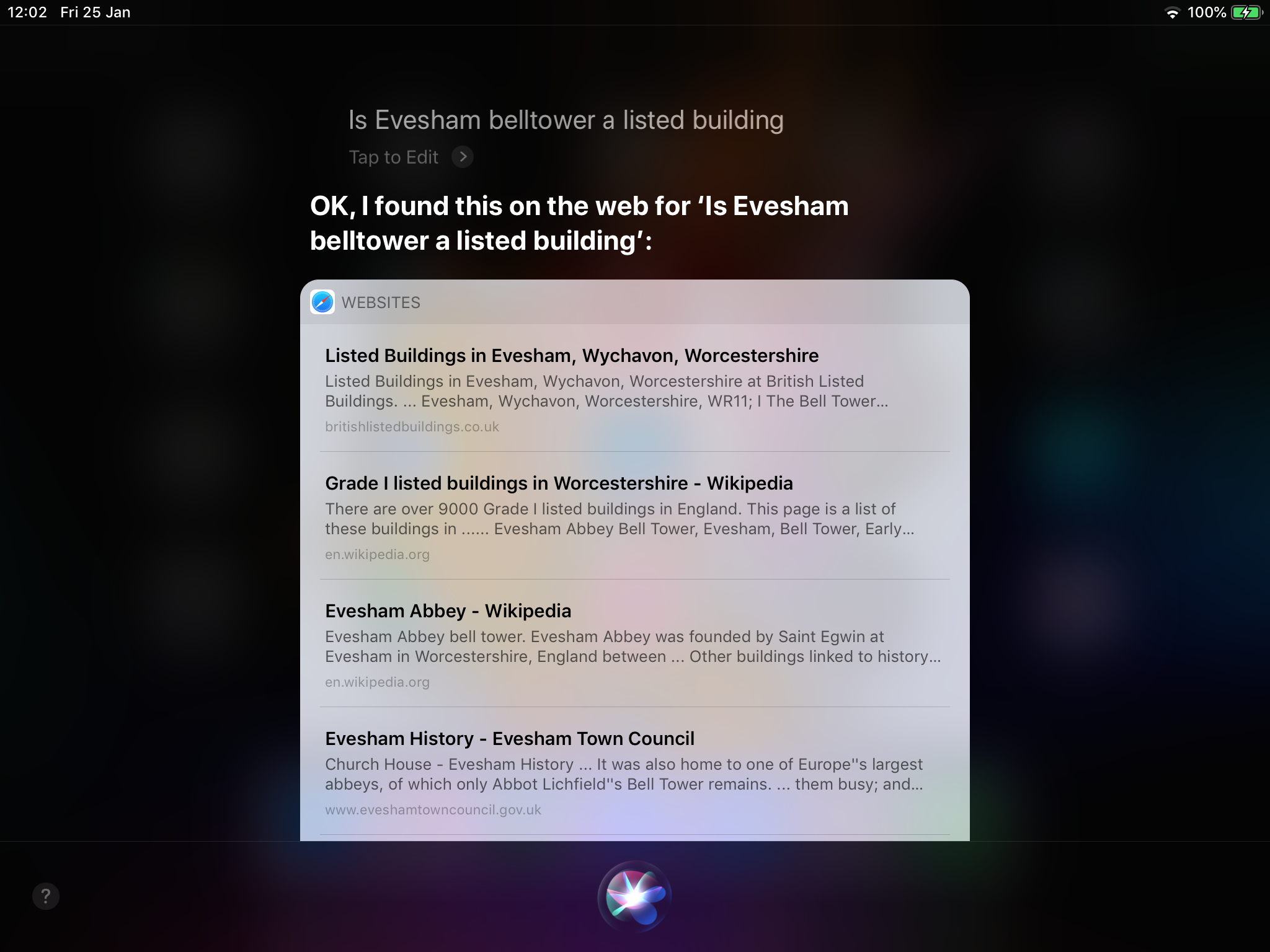
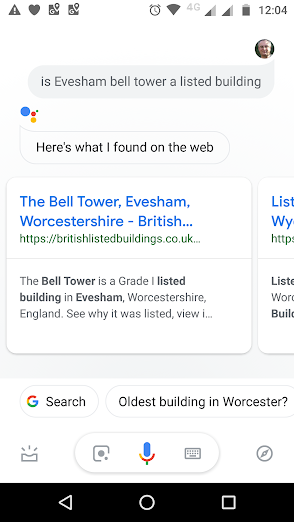
Getting traffic from Siri relies on the same basic techniques as any other search engine – that is, SEO. Just to prove that, here’s the result from asking both OK Google (on a phone) and Siri (on an iPad) the same question:

Both of those return the same website as the first result for that question (as, indeed, they should – it’s my website, and I’m good at SEO). But they return different pages from it. It’s interesting, too, that Google has spelled “bell tower” as two words, while Siri writes it as “belltower”.

And that, I think, answers the question “What happens next?” in the digital content world. SEO is back, in a big way, and bigger than viral marketing. But it’s SEO built around spoken commands to a digital assistant as well as typed into a web form. And that will come with its own challenges.

The first of those challenges is that people use digital assistants differently to how they use a web form. They speak to Siri like they would anyone else, in full sentences. If I was making the same query on the web, I’d just type “Evesham bell tower listed building”, without the spurious (for search purposes) “is” and “a”. Fine-tuning SEO for natural language queries, rather than targetting web-based keyword queries, will be important when it comes to making Siri your friend.

The other is illustrated by my two screenshots. Different speech recognition engines will convert your speech into different text. There may not be a huge difference between “bell tower” and “belltower”, but there are circumstances where it will have a significant effect on how the query is interpreted, and hence answered. Spoken word SEO will need to take account of that, and particularly so given that, while Google still overwhelmingly dominates the web search market, Siri is the leading digital assistant – and, by default, Siri searches the web using Bing. So a lot of the old SEO tricks that target the quirks of one specific search engine will be outmoded. More generic and cross-platform techniques will be necessary.

So the digital content bubble hasn’t burst. But the successful digital content of the future will be mobile-friendly, amenable to natural language searches and not targetted at users of any one search engine or platform. And if that means the end of clickbait, that won’t be an altogether bad thing.

23 December 2018
by mark
0 comments

The ghosts of Christmas past

I suppose most of us have memories of childhood Christmas. For me, the classic Christmases past are the times we went to my grandparents’ house for Christmas dinner.

We’d start the day, as children always do, by waking as early as we could to see what Father Christmas had brought us, and then unwrap family presents in the living room. Then it was off to chapel for the Christmas morning service, and then to Grandma’s house for dinner.

My extended family is quite large, and there always seemed to be a houseful. Three generations were there, we children, our parents, aunts and uncles, and then as well as our grandparents, lots of great uncles and great aunts that I rarely saw any other time of year. We weren’t a particularly close family, but we were a congenial one, and these annual get-togethers were an opportunity for the gown-ups to catch up with each other’s news over the past year and, as always, tell us children how much we’d grown.

The routine was always the same. After dinner, the men would go for a walk, leaving the women to do the washing up, and then we’d all congregate in the back room to swap presents and play games. No fancy electronics, of course, or even the latest board games – instead, we’d play “Hunt the thimble” and “How many eggs in the nest?”. The air was smokey, partly from the fireplace and partly from the men’s pipes. Even now, the smell of pipe smoke instantly transports me back to Christmas afternoon at Grandma’s. We’d take a break from games and presents to listen to the Queen’s speech on the radio (not on TV, my grandparents didn’t have one!).

Eventually, the games and presents would be done, and our immediate family would move on – typically, mum, dad, my brother and I would go either to my other grandparents (dad’s side of the family), or to my aunt and uncle’s house, for tea. There would be more presents to swap there, and more games to play. And then home, eventually, to bed. As we got older, the routine varied more, and my teenage memories of Christmas are quite different. But my most precious memories of childhood Christmas are those early ones, where the routine seemed to be fixed in stone – this is how it had always been done, and this is how it ever would be.

What I didn’t know then – and didn’t learn for a long time – was how difficult my grandmother found it, sometimes. Not difficult physically – she enjoyed hosting the Christmas dinner, and with plenty of people to muck in and lend a hand the cooking and cleaning wasn’t an arduous task. But, emotionally, it could be challenging, because of the memories it brought back for her.

One of the things I remember from those early Christmases is sitting on my Grandad’s knee. That was usually the point at which Grandma had to leave the room for a moment to “wipe a speck from her eye”. And why, for a little while, she seemed a bit quiet, and distant.

Because Grandma’s own children – my mum and uncle – never got to sit on their grandfather’s knee. Their grandfather (my great-grandfather, and Grandma’s dad) died when Grandma was still only 13. And, of my grandparents’ generation, there was one missing from those Christmas gatherings that Grandma would dearly have loved to be there. Her older brother Ralph was killed in action at Ecoust-Saint-Mein, France, in August 1918, just six months after her father had died.

Christmas 1918 was a very different occasion for Grandma’s family to how it had been before. The loss of both of the family’s breadwinners caused an upheaval that uprooted them all from their home and not only cost Grandma the people she loved most but shattered her hopes and dreams for the future. I can only imagine how they felt, trying to celebrate Christmas that year. To be honest, I don’t even know if they did. Maybe my great-grandmother tried to keep it going, for the sake of the younger children. Or maybe it was too hurtful even to bother.

Fifty years later, with her own grandchildren sitting at the dinner table on Christmas Day, Grandma still carried the memories and pain. And she carried them with her until she died. My childhood memories of Christmas are all happy ones. So, for that matter, are nearly all my adult ones. But in this, the centenary of Grandma’s first Christmas without her dad and big brother, I’m uncomfortably aware that the ghosts of Christmas past still have power to haunt me.

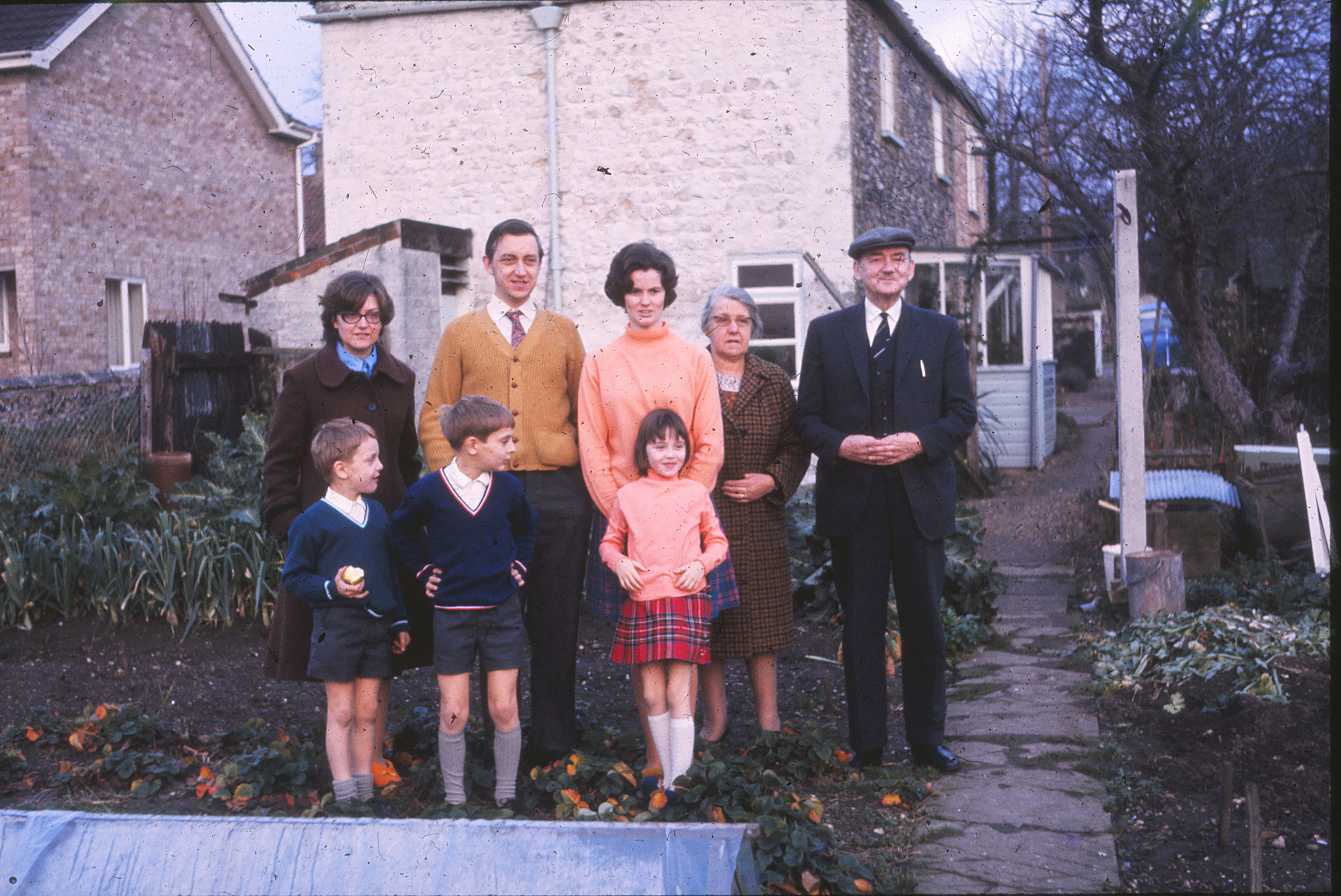
I don’t have any actual photos of an early family Christmas, but the one on this page is from the same era and location. It’s taken in the vegetable garden of Grandad and Grandma’s house in Lakenheath, Suffolk (more recent owners seem to have tarted it up a bit).

From left to right as we look at it, the adults are my mum, Uncle Peter, Aunty Jill, Grandma and Grandad. The children are my brother Stuart, me, and our cousin Judith. Dad isn’t in the photo because he’s behind the camera.