Mark's Musings

A miscellany of thoughts and opinions from an unimportant small town politician and bit-part web developer

9 November 2018
by mark
0 comments

Remembering Armistice

This is a sequel to my previous post, relating my visit to the graves of my relatives killed in WWI. I had initially hoped that I might have time on that trip to include a visit to the Glade of the Armistice near Compiègne, but in the end I had to give it a miss as my schedule didn’t allow it. However, an unexpected short-notice return to France as part of an official visit to our twin town of Dreux left me with enough time to call in on the way back to Calais afterwards. This is an account of that visit, and some more general musings on war itself.

The weather in France is grey and rather damp, just like the last time. Heading back to the Channel from Dreux, I take a slight detour at Compiègne to visit the Clairière de l’Armistice, or Glade of the Armistice in English, where the Armistice of 11 November 1918 that ended the Great War was signed.

Technically, an armistice isn’t a peace treaty, it’s simply an agreement to temporarily stop fighting. The armistice of 1918 had to be extended three times until the Treaty of Versailles was signed in 1919, which did formally end the war and re-establish peace. But the armistice, rather than the Treaty, is generally regarded as the end of the war.

The armistice was signed in a carriage forming part of Allied supreme commander Marshall Ferdinand Foch’s private train. Foch had chosen to hold the armistice talks in a clearing deep in the forest near Compiègne, partly because it was easily accessible by rail and partly for the privacy it afforded. Foch didn’t want journalists present, and was also concerned that the German delegation would be attacked by angry locals if they were seen in public.

Nine years after the armistice, the carriage where it was signed was returned to the forest as part of a newly constructed memorial, now known as the Glade of the Armistice. The carriage was housed in a specially constructed building just outside the Glade. The actual location of the signature is marked by a plinth.

Annoyingly, I discover that the central part of the Glade itself is closed to visitors, presumably to allow for work in preparation for the major events that will take place here in November. But the museum is open, so I pay my €5 and go inside.

The museum is certainly interesting, and I’d recommend a visit to anyone if you have the opportunity. But, while informative, I do feel something of a lack of any real historic connection to the events of 1918. The carriage in the current museum is not the original. It is a genuine, identical carriage from the same train, but it’s not the one where the armistice was signed. Equally, the museum is not the original building. In fact, there’s only one part of the original memorial, constructed in 1927, which remains. And I can’t get close to that as it’s inside the fenced off section. But the reasons for that are, possibly, even more telling.

The armistice wasn’t officially a surrender by the Germans, but it might as well have been. The conditions imposed by the Allies on the defeated Central Powers, and Germany in particular, were sweeping and punitive.

At the time, that made sense. Germany was the aggressor, and had been defeated. The Allies wanted to ensure that Germany not only suffered for their behaviour, but were in no position to be a threat again. The demilitarisation of Germany, and the destruction of German military hardware and infrastructure, was a justifiable and proportionate response.

At least, that’s how it looked in 1918.

Leaving the museum, I find that I can actually get into the central part of the Glade via a hole in the hedge. I don’t go too far in, because I don’t want to get spotted and told off, but I do manage to get a few photos. Some parts of the memorial are protected by electric fencing, although I presume that’s aimed more at animals than cheeky intruders like myself.

As originally constructed, the Glade was a monument to French military prowess and the humiliation of Germany. At the entrance to the Glade is the Alsace-Lorraine Monument which features the German eagle being slain by the French army. A significant feature of the Glade was a stone tablet bearing the inscription

ICI LE 11 NOVEMBRE 1918 SUCCOMBA LE CRIMINEL ORGUEIL DE L’EMPIRE ALLEMAND. VAINCU PAR LES PEUPLES LIBRES QU’IL PRÉTENDAIT ASSERVIR

or, in English,

HERE ON THE 11 NOVEMBER 1918 SUCCUMBED THE CRIMINAL PRIDE OF THE GERMAN REICH. VANQUISHED BY THE FREE PEOPLES WHICH IT TRIED TO ENSLAVE

Of course, with the benefit of hindsight we know that German demilitarisation didn’t last. Nor did the peace brought by the armistice. Only thirteen years after being constructed, and only 22 after the armistice was signed, the Glade constructed as a memorial to French military triumph became the scene of French military humiliation. On 22 June 1940, German troops smashed the walls of the museum in order to roll the carriage back onto the precise spot where the armistice of 1918 had been signed, and the leaders of France, in the presence of Hitler, were forced to sign their own surrender at the very same desk.

The Germans then destroyed the entire site, with the exception of the statue of Marshall Foch which was deliberately left overlooking a wasteland. The carriage was taken to Berlin. It, too, was later destroyed in the final days of the Second World War. Which is why everything at the Glade now, with the exception of Foch’s statue, is a reconstruction, a replacement or a new addition.

Leaving the Glade, and with some spare time left, I go for a walk through some of the forest. Footpaths and cycle paths have replaced the railways which brought Foch to the clearing, and the area is now a significant leisure destination. It’s a far cry from both 1918 and 1940.

A visit to the Glade is instructive, though, particularly when comparing the two wars it played a central role in. The armistices it hosted were different; the first was the end of a war, the second was an early step on what the winners hoped would be a march to overall victory. But both were deliberately designed to humiliate the defeated army, and both succeeded in that aim.

The second war didn’t end with an armistice like the first, though, or like the second armistice signed at the Glade. And the reasons for that are worth noting.

I’m always a little uncomfortable with rose-tinted wartime nostalgia. There’s a kind of “Goodnight Sweetheart” folksiness about a lot of our cultural memories, which tends to play down the darker side. There’s a subtext to many wartime re-enactments, such as those popular on heritage railways, which gives the impression that that was somehow a better, purer time – reinforced, sometimes, by a belief that the modern world has lost its way.

I appreciate that the “Blitz spirit” is real, and that the camaraderie of those determined to pull together through adverse circumstances is to be celebrated. So, too, is the heroism of those who actually take part in the fighting – although we should be careful of excessively honouring those who, in reality, were merely more lucky than their comrades. But we need to be careful not to airbrush the realities of war. I find “Dads Army” as funny as everyone else, but in reality the characters in that show would all have had family and friends out on the battlefield being killed or crippled. Finding humour in tragedy should not be allowed to minimise the tragedy.

I’m not a pacifist. I believe that war is sometimes justified and necessary. But it’s necessary in the same way that chemotherapy, or open heart surgery, is necessary. Not because it is a desirable goal in itself, but because the alternative is worse. But, just as a person’s condition has to be pretty serious to justify putting them on an operating table and slicing their chest open with a saw or dosing them up with drugs that can kill as easily as they can cure, so war is a last resort for dealing with an otherwise intractable problem that, if left unaddressed, will only cause more harm.

Even when it is justified, war is still a terrible thing. War kills people. War tears families apart. War devastates communities. War destroys infrastructure. War always leaves everybody – including the victors – worse off than they were when they started.

But that is something that we – thankfully – learned as a result of the two World wars. It’s now generally accepted that one of the root causes of WWII was the harsh and unfair treatment meted out to Germany at the end of WWI. Far from preventing another war, the armistice agreement stoked up resentment and paved the way for a populist leader to plunge the world into an even greater conflict.

The Second World War ended differently. Although, militarily, Germany’s defeat was far more comprehensive, being invaded and occupied by the Allies, the aftermath followed a different course. Instead of humiliating Germany, the primary aim of the Allies was to rebuild it as a modern, democratic state.

Looking back at the post-war history of Europe, it has to be said that the plan worked. Although there have been smaller, more limited conflicts on the continent, there has never been anything like a full-scale war. Even elsewhere in the world, although there have been many local and regional conflicts, none have spilled out into the wider area.

Peace is fragile, and so is democracy. There is no room for complacency. But we are heading in the right direction. The number of wartime casualties has been on a consistent downward trend since the end of WWII, even despite well-known conflicts in Korea, Vietnam, the Middle East and the Balkans. The number of wars between states has reached an all-time low. Only the persistence of civil conflicts, particularly in the Middle East and Asia, keeps the death toll ticking over.

It’s unlikely we will ever eliminate war. Not least because authoritarian regimes tend to generate internal opposition, and it’s easier now than it ever was for opposition to be armed. While the amount and deadliness of major international conflicts has decreased, the number of small, limited internal conflicts has risen. Governments are less likely to take up arms to attack another country, but more likely to take up arms to repress their own people. And, when they do, their people are more likely to take up arms and fight back.

The challenge for anti-war campaigners has, therefore, also shifted ground. Where the focus was once on persuading states not to attack each other, the priority now has to be on preventing internal conflicts. And, in practice, that has to mean supporting the spread of democracy and human rights. By far and away the largest numbers of military casualties now occur in civil wars in totalitarian and authoritarian states. Those of us who are fortunate enough not to suffer from them have a responsibility to stand up for the benefits of democracy and the basic rights of all humanity to live in freedom. The legacy of 1918 demands nothing less.

One of the key features of the rebuilt Glade of the Armistice is the Peace Ring. This is a bronze ring, 3.5m in diameter, bearing the word “Peace” in 52 different languages. Where the Glade was once a memorial to military triumph and humiliation, it now stands as a vision for the ending of all war. Sneaking through the hole in the hedge, it’s the only one of the monuments within the clearing that I’m actually able to get close to. It’s a good way to end my visit to the Glade. And a good message to take home with me.

21 August 2018
by mark
0 comments

Three graves, two countries, one war, one hundred years on.

Three of my relatives (two of my grandfather’s older brothers, and my grandmother’s oldest brother) are buried in the war graves of the Western Front. I’ve been meaning to visit them for some time now. This year I finally got round to it. This is a short account of my trip.

You can see the rest of my photos from the trip at Facebook (if you have an account) or Google Photos (no account necessary)

Six o’clock on Sunday morning, and I manage to catch the alarm a minute before it goes off and avoid waking anyone else up. Breakfast, finish packing, and I’m heading down the motorway at the start of a two-day visit to Belgium and northern France to see where my family’s three casualties from the First World War are buried. Oddly enough, the longest single journey on the trip is the drive to and from Folkestone. I’ve picked shuttle dates and times to try and minimise the prospect of being caught in congestion on the M25.

Exiting the tunnel shortly after 2pm local time, my first target is Poperinge, a Belgian town west of Ieper and close to the French border. Lijssenthoek is just to the south of the town.

I miss the turning the first time I pass it, and only realise that I have when I see that I’m already heading away from Poperinge on the other side. Turning round, I retrace my course with the aid of Google navigation. Not that I need to, because the cemetery is signposted when approaching from this direction – but not from the direction I originally came from. My guess is that the assumption is that most visitors are coming from Ieper.

8867 PRIVATE R. GOODGE
SUFFOLK REGIMENT
22ND JANUARY 1916 AGE 21

GOD TAKES OUR LOVED ONES FROM OUR HOMES BUT NEVER FROM OUR HEARTS

Lijssenthoek Military Cemetery is huge. Over 10,000 casualties are buried there, which is more than the population of Littleport, Robert’s home village where his parents, Henry and Amelia Goodge, lived and worked the land. As well as Commonwealth casualties, the cemetery also has a sizeable French section, and, at the back, under the trees, a small row of German graves.

One of the first things you notice is how close the gravestones are together. Unlike the municipal cemetery just down the road from where I live, there’s no space to walk around individual plots. Instead, the headstones stand in serried rows, shoulder to shoulder. There barely seems space for a grave in front of each one.

That’s because there isn’t space. Only officers got a grave to themselves. Other ranks were buried two, or sometimes three, to a grave. The headstones stand side by side as close as possible to the burial plot. But they don’t mark its precise position. In some WWI cemeteries, casualties share a headstone as well as a grave.

Interestingly, although the majority of gravestones are marked with the Christian cross, it isn’t universal. Casualties known to be members of other faiths use, where appropriate, their own symbol – for example, Jewish casualties have the Star of David on the headstone. Others have no religious symbol, but use appropriate inscriptions. A Sikh casualty has text in Gurmukhi script. A Chinese labourer has his name written in Chinese. This early example of multiculturalism contrasts somewhat with the French graves, which are uniformly crosses.

Robert served in the 2nd Battalion of the Suffolk Regiment. The original 2nd Battalion had effectively been wiped out at the Battle of Le Cateau on 26 August 1914. Robert avoided that action, and survived the battalion’s involvement in the Winter Operations of 1914-1915. But, on 22nd January 1916, while the 2nd Suffolks were engaged in trench warfare near Ieper, Robert’s luck ran out.

It was a fairly quiet time for the casualty clearing centre. Only four people died that day.

There’s a timeline on the wall of the cemetery visitor centre showing the number of deaths per day. Mostly, it’s in single digits or low double digits. Later, it rises to the hundreds. In front of the cemetery there’s a row of iron bars, one for each day of the war that contributed casualties to Lijssenthoek. The number of casualties each day is shown by the number of notches at the base of the bar.

It feels a bit strange to be standing in front of a gravestone with my surname on it. It’s not the first time, of course, all of my grandparents are now deceased and I’ve stood in front of their graves. But it’s different when it’s the grave of someone who has lived a full life, and someone whose life was cut short in its prime.

The cemetery is, as you might expect, busy. A coach party arrives while I’m there. The centenary of the war has increased visitor numbers. But it still feels sombre, reflective. Despite the number of people walking round, it’s practically silent apart from the sounds of nature. Conversations are in hushed tones, and soaked up by the grass and flowers.

Any death in combat is a tragedy. But some deaths are more tragic than others. Robert was young, he had no wife or children, and the family he did leave behind were strong enough to cope. The same wasn’t true of the other casualties I am here to pay my respects to.

Leaving Lijssenthoek, I head for Ieper (or Ypres, as it’s more commonly known in English), where I’m staying the night. After checking into my hotel, I have time to spend in the town.

I’ve been to Ieper before, when I briefly worked in Brussels back in the 1990s. Had I known then that one of my relatives was buried nearby, I’d have paid a visit to Lijssenthoek too. But, I didn’t. The town itself is still very recognisable, but it feels a lot more vibrant – there are more people in town, despite it being a Sunday evening, and the Grote Markt and the road leading to the Menin Gate are lined with bustling cafes and restaurants. How much of that is WWI centenary tourism, and how much is the local economy, is hard to judge.

The Menin Gate itself is certainly a focus of a lot of centenary commemoration. The stairs leading up from ground level to the ramparts are lined with flowers and wreaths, and in between the gate and the Indian Forces memorial is a display of wreaths from British Legion branches across the UK. They aren’t in any kind of order, but, after systematically walking through the display I find those from both where I live now and where I come from – which, of course, is also where my great-uncles are from.

Monday morning, 8am local time and I’m on the road again. Leaving Belgium behind, I cross back into France just north of Lille. Both of today’s destinations are just outside Arras, about an hour and a half away. It’s rush hour in France, but it’s also the holiday period and traffic is lighter than I’d expected (and Google had predicted), so I’m not spending too much time in jams. It’s a dank, grey morning, and drizzling a bit.

This time, I make no mistake with my navigation and reach the village of Wanquetin, to the west of Arras, without any difficulty.

34480 PRIVATE J. W. GOODGE
DUKE OF CORNWALL’S L.I.
12TH FEBRUARY 1917 AGE 31

HAVE FAITH IN GOD THE SUN WILL SHINE THO’ DARK THE CLOUDS MAY BE TODAY

Unlike Lijssenthoek, Wanquetin Communal Cemetery Extension is tiny, containing just 232 graves. As the name suggests, it isn’t even a standalone site. Instead, it’s a small area tacked on to the rear of the village’s regular municipal cemetery. There’s no car park, no visitor centre, and nobody else here except me – although a van containing workmen from the Commonwealth War Graves Commission does turn up while I’m there. Despite that, it’s still instantly recognisable as a CWGC site – the white gravestones laid out in rows and the Great Cross following the standard design.

John served in the Duke of Cornwall’s Light Infantry, 6th Battalion. According to the CWGC website, he also served in the Military Foot Police. Like his younger brother Robert, John doesn’t appear to have died in any particular key battle. In the terminology of the time, he was just “trench wastage” – a casualty suffered as a result of artillery fire on soldiers who were manning their own trenches, not actively attacking the enemy. That may make him sound particularly unlucky, but that’s far from the case. Although the big set-piece battles generated a lot of casualties in a short space of time, they were also relatively infrequent. Overall, more servicemen died in their own trenches than when going over the top. One of the most grindingly depressing statistics of WWI is the number of casualties – on both sides – suffered for no gain. Trench warfare was so effective defensively, but so ineffective offensively, that for much of the time the combatants just lobbed shells at each other in the hope that the enemy would run out of recruits before they did.

Sidney and Irene Goodge at John Goodge’s grave

John’s grave has a particular resonance for me, as one of the earliest photographs I have of my own grandfather is of him and my grandmother (or my nan, as we called her) visiting John’s grave, some time in the inter-war period. Grandad was fortunate, he was too young to fight in WWI and, as a farmer, too important to the war effort at home to be allowed to fight in the next – something for which I am incredibly thankful. No immediate members of my family were killed in WWII, although my other grandfather – my mum’s dad – did get called up, and served in the Far East.

I’m glad that I’m alone here in Wanquetin cemetery. This is a far more emotional experience than Robert’s grave, and don’t particularly want to share that with other visitors. Unlike Robert, John was not young, free and single when he went to war. On 17 October 1907, at St Leonard’s Church, Little Downham, John married Emma Jane Martin. John and Emma had one child, a daughter, Mary, born in 1911. John’s death left Emma a single mother. But worse was to come. Six months later, Emma died – her death certificate described the causes as peritonitis and a gastric ulcer – leaving Mary an orphan at the age of six.

Nobody knows what happened to Mary. It’s likely that she was brought up by her aunt and/or grandparents. But she disappears off the record books. There’s no death certificate in her name, no marriage certificate, no entry in the census. The most plausible assumption is that, in the care of her mother’s side of the family, she took their surname and, possibly, a new given name as well. But that’s just speculation.

I’ve often wondered what happened to Mary. Standing here, at her father’s grave, it’s impossible not to think of what might have been had he not died. My own children aren’t much older than she was when she was orphaned. Joseph Stalin is reputed to have said that one death is a tragedy, but a million deaths is a statistic. Around 15 million people died in WWI, but every single one of those deaths was somebody’s personal tragedy. John’s death was Emma and Mary’s. And here, just over a hundred years later, I still feel it.

The drizzle has stopped, and the skies are brightening a bit, as I leave Wanquetin. It’s only a short drive to my next, and final, destination, the village of Ecoust-Saint-Mein.

45935 PRIVATE R. F. WATTS
SUFFOLK REGIMENT
30TH AUGUST 1918

There’s no inscription on Ralph’s gravestone. Not every gravestone has one, for a variety of reasons. One of the most common was cost – the relatives had to pay to have one added, and not everybody could afford it. But that wasn’t the issue in Ralph’s case.

Ecoust-Saint-Mein British Cemetery is another small one, although in this case it is standalone rather than being attached to a domestic cemetery. It contains 143 graves, all from the First World War.

Ralph Watts

I’ve deliberately left Ralph until last. Although he doesn’t share my surname, and left no widow or children, his death was part of a chain of events that brought me into the world. He’s also the only one of the three that I have a photograph of, and the one I know most about.

Ralph served in the 2nd Battalion of the Suffolk Regiment, the same as Robert Goodge. Whether they actually knew each other is a matter of speculation. Although their respective families were later to combine to form my own immediate ancestry, there’s no reason why they would have had any link at the time. They came from different villages and weren’t in any way related.

The records say that Ralph was the son of Grimmer and Rebecca Watts, of Burwell. He was their son, certainly, but by the time he died he had no father. Grimmer had died six months earlier. From all accounts, Grimmer’s death was sudden. Rebecca was still mourning him when news of Ralph’s death came through. Relatives reported afterwards that Ralph’s death barely seemed to register with Rebecca, she just mentally tuned out the news. That’s why there’s no inscription on Ralph’s gravestone. She seemed, at the time, almost cold-hearted about it. Not that that tells us anything about how she actually felt. Grief hidden can be just as powerful as grief displayed.

But the practical consequences of losing her husband and eldest son in a short space of time caused a family upheaval that saw Rebecca sell up the family business and, with her younger children, move back to the village of Lakenheath where she had grown up. And the person hit hardest by the upheaval was Ralph’s sister Hannah, my grandmother. At the age of 13, her life was turned upside down and almost everything she loved was lost.

Again, I’m pleased that I’m alone in the cemetery. Robert’s death was pointless, John’s death was tragic, but neither affected people I knew to the extent that Ralph’s did. Henry and Amelia Goodge, and the rest of their children, got on with life after John and Robert’s deaths. And, to be honest, not a lot changed for them. But Ralph was different. Standing in front of Ralph’s gravestone, I’m acutely aware that I’m looking at something which did affect people who were close to me. I can only imagine how Emma and Mary felt when John died. But I know how Hannah felt when Ralph did.

And that knowing makes it impossible not to feel it, too. To share Hannah’s grief. Here, in a small cemetery in rural France, I feel more connected to my grandmother’s memories than I ever have done. And I can feel the tears on my cheek as I sit on the cemetery wall and try to make sense of it all. And I’m glad I came. Glad that I’ve been able to pay my respect to my family members who made the ultimate sacrifice. And angry, too, that so many lives were wasted for so little.

Unlike Robert and John, Ralph did actually die in battle. The village of Ecoust-Saint-Mein was captured by British forces in April 1917, lost again in March 1918 and retaken in August 1918. It was during this final battle that Ralph was killed. That may seem a little pointless, for a tiny village of no strategic significance. But this battle was part of the “Hundred Days Offensive”, the Allied advance that finally pushed the German forces out of France and culminated in the Armistice agreement. It’s no comfort now, but Ralph’s death was, at least, worth it for the war effort.

Midday on Monday, and I’ve finished my tour of cemeteries. I’ve got some USB sticks of music with me in the car, because I can’t listen to the radio (well, not my normal station, anyhow) while I’m outside the UK. Somehow, though, I haven’t felt like listening to music, so all my previous driving south of the Channel has been in silence. It just hasn’t felt right. But now, with half a day to spare sightseeing before I need to catch the shuttle back to England, the atmosphere is different. And the sun has come out, too. I wind the window down, shove a stick in the player and head out across the French countryside.

Footnote: There’s no happy ending for any of these personal tragedies, unless something wonderful happened to Mary that we simply don’t know about. But Hannah’s story does contain an uplifting interlude. It comes in the form of what she described as “The best letter I’ve ever received”. It was actually a telegram, dated 20 November 1945, and it read, simply

Arrived Southampton expect home shortly
Hubert

Having lost her brother and father, and seen her mother have to cope as a widow and single parent, the joy of knowing that her husband had returned home safely from his war was news she was desperately hoping for. And it meant that my parents’ generation – mum, and Uncle Peter – didn’t have to go through what she had. The best letter, indeed.

The best letter my grandmother ever received

14 June 2018
by mark
1 Comment

GDPR and the local councillor

GDPR has been in the news a lot lately, and rightly so. It makes some significant changes to data protection law in the UK (and elsewhere), as well as making some practices compulsory that were previously merely recommended best practice.

I’m not going to try and provide a detailed analysis of GDPR here. But, from conversations with council colleagues, I felt that it might be helpful to go over a few of the aspects of it that are most likely to affect local councillors.

The ICO’s guidance

The ICO’s position is that councillors should register as data controllers. So far, this advice hasn’t been tested in court. However, my understanding of the relevant legislation is broadly the same, and I’m certainly not going to argue with the ICO’s legal team.

However, there are issues here. Registration is not free. And, while principal and county councillors get an allowance which, in most cases, more than covers essential costs such as this, parish councillors don’t. It can be hard enough to get people to stand for parish councils as it is, and making them pay for the privilege of being elected (or co-opted) is hardly going to help. I would hope that the ICO would recognise this, and introduce a free tier of registration for unpaid elected members of public bodies.

Another problem with a lot of the ICO’s published guidance is that it repeatedly refers to “businesses”. That can be misleading, as it implies that non-business users of data – such as councillors – aren’t affected by GDPR. But that’s the wrong way round. GDPR applies to everyone unless their use falls under one of the defined exemptions. And council work isn’t one of them. So GDPR definitely does apply to councillors, and councillors need to understand how it affects them.

Consent is not everything

You will, I’m sure, have been bombarded by emails from various organisations asking you to re-consent to getting communications from them. And you may have seen stories on social media of even more extreme examples, such as GP surgeries asking for consent to send you appointment reminders by SMS.

However, a lot of this is unnecessary, and results from a misunderstanding of the law. The one thing you absolutely do need explicit consent for is sending marketing material electronically (eg, by email or SMS). As a councillor, that will affect you at election time as election material is deemed by the ICO to be marketing. So you can only send campaign emails to people who have explicitly opted in to receive them. But that is only a tightening up of existing best practice, so, unless you have previously been sailing close to the wind, that’s not going to be an issue.

Lawful use of data

You do not, though, need to get explicit consent to process the data of people who contact you in our role as a councillor asking you to help them with a problem or to report an issue with council services. If someone has asked you for help, it is obviously in their interests for you to help them, and in your interests to do so effectively.

So in this case, your justification under GDPR for processing their data (including communicating with them) is what the legislation calls “legitimate interest”. And your council, if and when you pass the complaint or issue on to them, will be able to act under the “public task” justification. (So, actually, might you; the ICO’s guidance isn’t entirely clear on this point and, again, it has yet to be tested in court). Neither of those require consent.

One thing you can’t do, though, is take the details of someone who has contacted you in your role as a councillor because they are asking for your help, and then use them for other purposes. In particular, you can’t use them for electioneering, as that’s marketing (see above).

Security matters

What really does matter is data security. GDPR significantly toughens up the rules about how you look after data in your possession, including a requirement to notify the ICO if your suffer from a data breach and considerably greater penalties for any shortcomings in your security practices.

This is probably the single biggest effect that GDPR will have on councillors, and an effective understanding of data security is essential.

Councillors, by nature of the role, will inevitably be in possession of other people’s personal data. And in many cases, this will extend to what the legislation refers to as “sensitive” data – for example, health records, religion, even an individual’s politics! So you need to take care to ensure it is stored securely.

What is an appropriate form of security will vary according to circumstances, and there’s no one-size-fits-all solution. But these are some things that form a good starting point:

  • Paper records (including written correspondence) should be stored in a lockable filing cabinet.
  • Portable devices (iPads, laptops, etc) should be protected by, at minimum, a secure password and/or PIN.
  • Where possible, personal data stored on a device should be encrypted so that it is unreadable even if the device is dismantled and the storage removed. If that isn’t possible, try to avoid storing sensitive data on the device’s local storage at all. It’s safer to use it as a means of accessing a remote, and secure, data store.
  • Every account that you have on any local device (such as a laptop) or external system (such as an email provider, or a council intranet) should have a strong, unique password known only to you. Check your passwords against have I been pwned.
  • Do not share your passwords with anybody else. Where there is a genuine requirement for someone else to have access to personal data that you control, then give them their own access to it rather than letting them share yours.

Storage and retention

Don’t store data longer than you need to. Obviously, how long that is will depend very much on circumstances. This is another aspect where confusing and, in some cases, downright misleading information has been doing the rounds of the Internet. You certainly don’t need to delete every email immediately after you’ve read it and shred every letter before sunset.

Again, this is where the reasonable expectations of residents will come into it. People who need to contact you a second time regarding an issue will clearly expect that you still have their previous correspondence. And people who contact you regularly (and all councillors will have those!) will, often, expect you to be able to instantly recall every detail of everything they’ve contacted you about in the past!

So don’t go overboard on cleaning out data that has a reasonable prospect of being needed again. But, equally, don’t be a data hoarder. For email, have a standard retention period on your main inbox, but then move stuff you need to keep to a separate mailbox that doesn’t get automatically deleted (and review its contents regularly). For paper correspondence, have a regular sort out of stuff you need to keep and stuff you don’t. And shred the latter.

Backups

On the other hand, you should make sure that your data is securely backed up. This is standard IT good practice anyway, but the more important your data is, the more it matters.

The key word here, though is “secure”. Backups have to be kept separately to the device that they are backing up, but they need to be kept in a secure location that only you have access to. If you are storing them offsite (always a good idea), then use a service which encrypts your data so that even the providers of your backup service can’t read it.

Don’t let backups become long term archives. That’s not what they’re for. Backups are a snapshot of your current live files, so that, if something happens to your laptop, or your iPad, or whatever, you can recover them. If you no longer need to store data locally, then it doesn’t need to be in the backups either.

Email

Email is a particular issue for councillors as it has become pretty much the default means whereby we communicate with each other, with officers and with residents. Good data security practices apply to email as much as anything else, but there are some additional factors to consider.

Don’t use a shared email account for council-related email. If you are fortunate enough to be able to have staff helping you on casework, then giving them delegated access to your email is acceptable (although bear in mind that you are still responsible if they screw up). But don’t use an email account that’s shared with someone else. None of these “Mr and Mrs Jones” or “The Bloggs Family” type accounts. Council email should always be on an individual account that you, and you alone, control.

Ideally, council email should be separate to your personal email. If your council provides councillors with email addresses (eg, in the form of your.name@council) then make sure you use that exclusively for council work. If not, then I’d recommend getting a separate email address specifically for council work. It’s easy enough (and free) to create an address at any of the major webmail providers, such as Gmail and Live Mail, and their security is good enough for this kind of use. But be wary of smaller providers that may not fully encrypt mail stored on their servers.

Take GDPR seriously – but don’t listen to the hype

There are a lot of scare stories about GDPR doing the rounds. Most of those revolve around the false belief that GDPR requires consent for every form of data processing. That is so untrue as to be laughable. But it is, nonetheless, a common misapprehension. Another common misbelief is that GDPR only applies to email marketing. That’s not true; it applies to every form of personal data processing (unless covered by an exemption).

However, we are still in the early days of GDPR, and many of its aspects haven’t yet been tested in court. Until then, we don’t know which side of the line some edge cases will fall. And council work is, unfortunately, the sort of thing which is likely to generate those edge cases, as it isn’t as easily classifiable as most commercial uses of personal data.

ICO guidance, and case law, will inevitably evolve in the light of circumstances which need to be tested.

What that means is that keeping up to date with the current interpretation and best practice of GDPR is as important for councillors as keeping up to date with, for example, planning policy and licensing law.

Resources

Don’t just take my word for it. There are plenty of online resources that will help you navigate GDPR. Here are a few of them.

8 June 2018
by mark
0 comments

Eight websites every politician should bookmark

The Internet is both a blessing and a curse for politics. On one hand, it offers unprecedented access to a global wealth of knowledge. On the other, it facilitates the spread of fake news and provides plenty of digital banana skins for the unwary.

With that in mind, here are eight websites (plus a few more) that everyone involved in politics should be familiar with. Used wisely, they will help avoid some of the more common pratfalls of online life.

1. Snopes

One of the quickest ways to make yourself look an idiot on the Internet is to inadvertently retweet or share an urban myth. One of the simplest ways to avoid looking like an idiot is to check potential urban myths before you share them. Snopes is one of the most comprehensive databases of urban myths (and fake news), and should be your first port of call when faced with something that you’re not familiar with.

See also: Hoax Slayer, Truth or Fiction.

2. FullFact

On similar lines, you want to avoid propagating badly referenced, misleading or even downright made-up information. FullFact is an independent charity that does what it says on the tin – it checks the facts behind the media stories of the day.

From a political perspective, FullFact has two crucial benefits. Firstly, it will provide you with plenty of ammunition to debunk the wilder claims made by your political opponents. Which, as any politician will know, is one of the more enjoyable aspects of the role. But, just as importantly, it will help you avoid making wild and unsupportable claims yourself. Which stops you being on the receiving end of an unwanted debunking. Either way, checking facts is essential to political competence, at any level.

See also: Channel 4 FactCheck

3. The Guardian and The Daily Telegraph

Yes, I know that’s two websites. But I don’t care. That is, in fact, part of the point.

If you are involved in politics in any way, you need to keep up with the news. Broadcast media and, on the web, social media have the benefits of immediacy. But to really know what’s going on, you need to be a regular reader of professional written journalism. And the two best ways of getting that on the web, at least for UK-based news, are the Guardian and the Telegraph. And you should be reading both of them.

Why those two? Because they are the only “broadsheet” daily newspaper websites without a paywall. The Telegraph does have some material that is for subscribers only, but that’s generally opinion rather than news so you’re not missing a lot by not being able to read it. The other free-to-read news websites are either tabloids, web-only outlets or the web presence of broadcasters. And, quite simply, none of those cover news on the web in anything like the quality and depth as the broadsheet newspapers.

Why both? Because it’s equally important not to let your news be coloured by someone else’s politics. In that respect, it’s helpful that the Guardian and the Telegraph represent broadly opposite ends of the political spectrum as far as the broadsheets are concerned. Reading both will give you a more rounded view, irrespective of which of them is closer to your own political perspective.

See also: The Sun and The Mirror will give you a similarly balanced tabloid perspective on the news.

4. Your local newspaper website(s)

I can’t link to these, obviously, as their identities will be different for everybody. But, whatever they are, they’re a valuable way of keeping an eye on what’s important in your local community. In particular, the letters page is often a more representative sample of local opinion that what you see on Facebook and Twitter (as well as, sometimes, being inadvertently hilarious or downright scary).

5. Wikipedia

A lot of people shy away from Wikipedia under the mistaken impression that, being entirely crowd-sourced, it isn’t reliable. In reality, that’s not the case. There is plenty of research which shows that Wikipedia’s reliability is remarkably good. And, of course, if you do encounter errors in it, you can easily fix them yourself! More to the point, the more important a subject is, the more likely it is that Wikipedia will be both accurate and unbiased.

Wikipedia’s other big asset is its breadth of coverage. There is practically no subject too obscure for a page. And its policy of requiring content to be referenced to off-Wikipedia sites makes it an excellent starting point for research, even if not every individual page is necessarily perfect all the time.

6. WhatDoTheyKnow

WhatDoTheyKnow provides an easy interface for members of the public to make Freedom of Information requests to almost every public authority in the UK, all the way from parish councils to government departments.

As a politician you won’t necessarily be using WDTK to place FOI requests yourself (although it can be a useful tool for them at times). But it also allows you to keep an eye on the sort of requests that your local authorities are getting. That can be a valuable heads-up on things that may later come more directly to your attention, as well as giving an insight into the sort of things that FOI officers have to deal with.

7. FixMyStreet

FixMyStreet, as the name suggests, is a way for people to report problems with their local environment – not just streets, but issues such as fly-tipping, graffiti and antisocial behaviour.

As with WhatDoTheyKnow, you probably won’t need to use this so much yourself as most politicians have more direct routes to report problems. But, equally, it’s something that’s worth keeping an eye on as it gives a good overview of the sort of things that people in your area are complaining about.

8. Google

Yes, really. “But”, I hear you say, “I already use Google every day. I don’t need telling to use it!”. Ah, but do you really understand how to get the most out of it?

When I was at school, I can recall being taught how to use a library. That is, taught how books were categorised and classified, and how to find what I wanted by identifying where on the shelves to look.

These days, the Internet is our library. And knowing how to find things on it is just as crucial. Understanding how to craft a search query that will take you to the material you want to see (and avoid all the stuff that the spammers are trying to steer you towards) is a key skill. For example, finding out whether a photograph really is what it purports to be in that social media post, or whether it’s just a stock photo, or tracking down the origins of something quoted in a blog or news article.

I really can’t overemphasise this. If you can master the advanced search functions of Google (or any other search engine), then it’s easy to track down real facts and reliable information. Without it, you are left at the mercy of what other people tell you.

See also: DuckDuckGo, Bing.

7 November 2017
by mark
0 comments

Abuse, and how not to deal with it

The political abuse and harassment scandal has, it seems, claimed its first life. Welsh Assembly Member Carl Sargeant has reportedly killed himself after allegations were made about his behaviour.

I have no idea whether Sargeant is or is not innocent of the allegations. Already, social media is awash with comments blaming his accusers for his death. There is a real risk that this will deter other people from coming forward with their own stories of abuse.

To be sure, this may serve as a harsh reminder that a throwaway comment may have consequences far beyond those intended. If this does make some people think twice before making trivial or frivolous allegations, then that will be a good thing.

But it is completely wrong to dismiss all allegations of this nature as being frivolous or trivial. Just because something is relatively low level (when compared to, say, an allegation of rape) doesn’t make it not worth reporting. It’s just as illegal to steal a tenner as it is to rob a bank of millions. And low-level sexual harassment and bullying still needs to be dealt with.

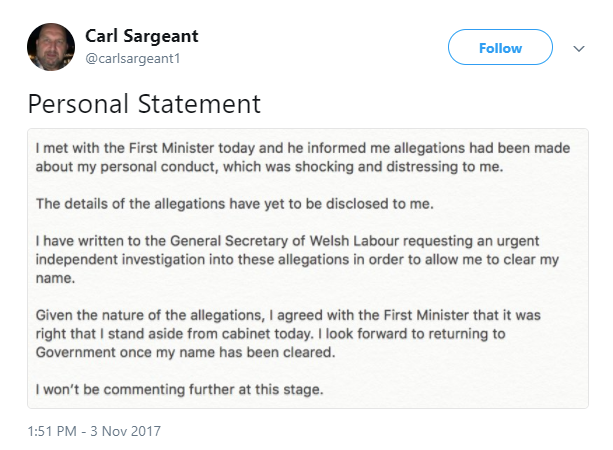
If there is blood on anyone’s hands, though, it seems to me that it rests on those who told Sargeant he was under investigation. He posted this on Twitter shortly afterwards:

Now, it seems to me that this is totally inexcusable. To be told that there are allegations against you, but not to be told what they are, is both cruel and a denial of the basic right to defend yourself against your accusers.

It’s worth noting, in this context, that the police can’t arrest you without telling you why you are being arrested. Anyone accused of a crime must, by law, be given all the information that will be used in evidence against them. There can be no justification for any internal disciplinary procedures failing to follow this basic principle of justice.

It seems to me that we need some basic guidelines in place to ensure justice for both the accuser and the accused.

People should think carefully before making allegations, and be sure that what they allege is not trivial or frivolous.

However, no genuine victim should ever be deterred from speaking out, and it’s better to err on the side of reporting the things that are too small rather than not reporting the things that are large.

Any allegation, of any nature, once made, must be taken seriously and investigated appropriately, whether that be internally or by referral to an external agency.

The subject of any allegation has a right to full disclosure of the allegation made, at the time that they are informed of the allegation, and to be kept informed of any information which later comes to light.

Both complainant and subject have a right to be treated with dignity and respect throughout.

The investigation should be neither rushed nor unduly delayed. Reaching the right conclusion is more important than reaching a rapid conclusion, but justice deferred is no justice at all until it is resolved.

This story will, no doubt run and run. Let’s hope that some good can ultimately come out of what is, undoubtedly, a tragedy.

You can call the Samaritans on 116 123. More contact details are on their website.

1 November 2017
by mark
0 comments

Don’t give a green light to abuse

Abuse, harassment, inappropriate behaviour. It’s been in the news a lot lately, particularly in relation to Parliament and politicians. Accusations range from the extremely serious, such as rape, to the relatively minor, such as an inappropriate touch on a knee.

I don’t particularly want to comment on the more serious allegations, not least because there’s a strong possibility that these will end up involving the police and CPS and thus become sub judice. And, also, I don’t think anyone would argue that rape is OK, or that people should have to put up with it. The issue in the specific case reported by Labour activist Bex Bailey is more about the way it was covered up rather than any attempt to justify or trivialise it.

There is, though, a repeated meme on social media that many of the lesser allegations are just mischief-making, and that they represent nothing more than everyday behaviour that people should just be robust enough to cope with.

I disagree, although I do accept that there’s a reasonable point to be made there. And, more importantly, not all supposed misbehaviour is, in fact, abusive.

I’m sure many people will have seen the so-called “sex pest spreadsheet” that has been circulating in various media outlets. In reality, much of the behaviour listed there is entirely normal and consensual (and, indeed, has already been widely reported in the media with no adverse comment).

Other inclusions seem more prurient than principled. I, for example, would not take part in what are euphemistically known as “golden showers”, but it is not for me to judge those who do. Equally, having “odd sexual ponchants” (sic) is only of significant concern if the particular oddity is that they are abusive. Otherwise, it’s a matter for those concerned, not for the authorities. Politicians have always been prone to affairs, but, while that may be an issue for their spouses, it is not really abusive in the wider sense.

However, some of the things on that list are abusive or inappropriate. And, where they are, they do need to be addressed. And they can’t simply be dismissed as trivial or unimportant.

This is where I take issue with those who say that what’s described in the spreadsheet as being “handsy” is too commonplace and trivial to care about, and that people should just develop a thick enough skin to brush it off.

To be sure, it is commonplace. And people who have to work in that kind of environment do develop thick skins. But that doesn’t make it right, or acceptable.

When I was at school, it was commonplace to describe people with darker skin tones as “P*ki” or “n*gger”. It didn’t really seem to bother the one black kid in my circle of friends, so presumably he had developed a thick skin about it. But that didn’t make it right then, and it wouldn’t be acceptable now.

Repeated inappropriately sexual behaviour, even low-level, is the same. It may well be commonplace. And, for a long time, it has been tolerated as normative and those who suffer from it have been expected to simply lump it.

But we are better than that now. We hold ourselves to a higher standard, and we have a right to hold others to a higher standard.

This is the real point here. Individual allegations of inappropriate behaviour come and go. Not all of them may be justified. Some may be mistaken, others may be malicious. We should never simply assume that every complaint is automatically credible and true. But, nonetheless, we should not tolerate an environment where abusers routinely get away with abuse simply because nobody else calls them out on it.

That doesn’t mean people can’t flirt, or engage in consensual behaviour. It simply means stopping to think about whether an action or comment is appropriate before moving the hand or opening the mouth.

It is not abusive just to have different sexual preferences to the majority. It isn’t abusive to have a consensual relationship with a colleague. It isn’t necessarily abusive, in the more general sense, to sign up to websites like Ashley Madison. It isn’t abusive to misunderstand someone’s intentions. Anyone can make a mistake occasionally, and misinterpret someone else’s actions as an invitation to more intimacy than was intended. I’ve sure we’ve all been there.

But when someone develops a reputation for being “handsy”, or “not safe in taxis”, or when multiple people report similar “misunderstandings” then it’s not just a simple mistake, or a different perspective on sexuality, but a pattern of behaviour. When someone refuses to accept there is even an issue, but instead accuses all allegations of being false, then that is a problem. And that needs to be challenged, no matter how important or senior the perpetrator. Staying silent, or trying to discredit those who do speak out, is just giving a green light to abuse.

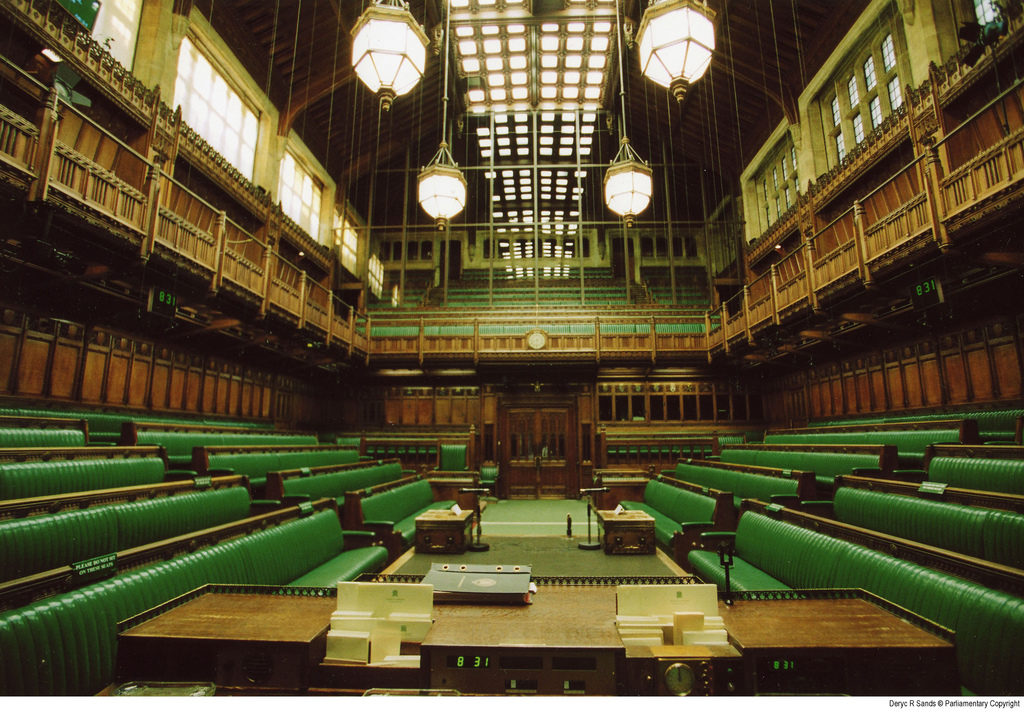
Image credit: The House of Commons Chamber. Image from UK Parliament; licence: CC BY-NC-ND 2.0

17 October 2017
by mark
0 comments

Website refresh

I thought it was about time I updated the website. I’ve moved it to a new, more reliable server (hopefully, no more of it regularly disappearing off the Internet every week!), put it behind CloudFlare to improve performance, and, finally, changed the design. It’s still running on WordPress, and eagle-eyed readers will spot that it’s now based on the default ‘twentyseventeen’ theme, but I’ve tweaked it a bit to look more the way I want it to.

All I need to do now is actually write stuff more often!

6 May 2017
by mark
0 comments

The “Progressive Alliance” is a figment of the imagination

Left-wing activists cling to the idea that there is an inherent anti-Tory majority, if only the opposition parties could get their act together and cooperate. Real election results, though, make it clear that there is no such thing.

Eight new “metro mayors” were elected this week. What’s interesting about mayoral elections is that they use the supplementary vote system – if no candidate gets more than 50% of the first preferences, the votes cast for all but the top two candidates are reallocated according to their second preferences.

If there is a “progressive alliance” among the electorate, therefore, the way that the second preferences are distributed will reflect this. As it happens, though, they don’t.

Of the eight mayoralties contested, four were won by Labour and four by the Conservatives. The Labour victories were all achieved with more than 50% of first preferences, so second preferences didn’t come into it. But the four Conservative wins all needed second preferences to reach a result.

In all four of those cases, the total Labour, LibDem and (where applicable) Green vote in the first round was more than 50%. So, if all of the Green and LibDem voters had given Labour their second preferences (or, in Cambridge and Peterborough, Labour voters had given the LibDems their second preference) the Conservative candidate would have been defeated in the second round (even assuming, charitably, that all the Ukip voters made the Tories their second choice).

So, when given the opportunity to vote for a progressive alliance, the electorate didn’t take it. At least some LibDem and/or Green voters must have chosen the Conservatives as their second preference (and, in Cambridge and Peterborough, some Labour voters must have done so too).

This is shown most clearly in the Tees Valley contest, where there were only four candidates and hence the possible interplay of second preferences between different minor parties can effectively be ruled out. In the first round, Labour’s 39% and the LibDem’s 12% add up to 51%, compared with the Conservatives’ 39% and Ukip’s 9% making a total of 48% (numbers don’t add up to precisely 100% due to rounding, before you ask!). But in the second round, the Tories won by 51% to Labour’s 49%. The LibDem voters could have put the Labour candidate into the mayor’s office with their second preferences, had they wanted to. But not enough of them did want to.

Now, I don’t find this at all surprising. It corresponds with a similar analysis of the 2015 general election, for example. But it still seems to be beyond the grasp of those clinging to straws in the hope that the centrist LibDem voters will somehow prefer Jeremy Corbyn’s Labour to Theresa May’s Conservatives.

27 March 2017
by mark
0 comments

Necessary hashtags and the art of detecting media bias

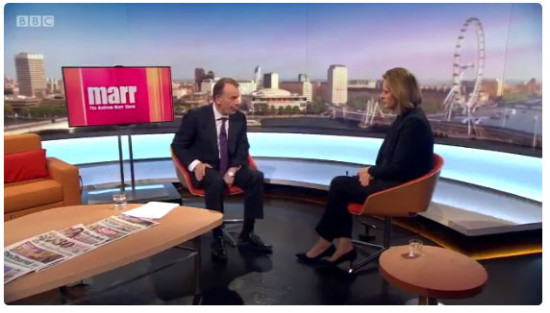
Twitter (or, at least, my particular Twitter bubble) has been busy this last 24 hours pouring scorn on the Home Secretary’s apparent admission in the Andrew Marr show on BBC1 (and later, in conversation with Sophy Ridge on Sky News) that she would consider legislating to force communication suppliers, such as WhatsApp, to break their encryption systems so as to permit governments to access messages.

I’m not going to rehash all the reasons why breaking or weakening encryption is wrong. Plenty of people more knowledgeable about it than me have already done that. I’m more interested in how she ended up making such a statement in the first place.

First, some background. The idea of forcing communication suppliers to add “backdoors” into their systems has been floating around for a long time, particularly in policing circles, as it would clearly be beneficial in some cases to be able to get at the content of every electronic message. So this is a proposal that tends to bubble up every time there is a major terrorist or criminal incident.

Such proposals have never actually come to anything, though, partly because they don’t stand up to technical scrutiny but also because they would be firmly resisted by many large and influential corporations – like banks and other financial institutions – as well as other government agencies which themselves rely on encrypted communications.

So, how did it crop up again this time, and why was the Home Secretary so willing to countenance it?

It’s important here to see the whole thing in context. If you haven’t already watched the full interview with Andrew Marr, then do so now on iPlayer before it expires. Because it’s clear that the first person to say something stupid in that exchange wasn’t Amber Rudd, but Marr. He introduced the topic of end to end encryption, made a complete hash of explaining it, and then invited Rudd to agree with him that it is “completely unacceptable” that the government can’t access terrorists’ messages on it.

This is intellectually unsustainable, but political dynamite. Rudd could not, realistically, disagree with him – imagine the tabloid headlines if she had dared to suggest that it is acceptable for criminals to be able to communicate in secret – but neither could she agree without falling straight into the trap that Marr had laid for her.

It was clear from that exchange that Rudd is not only uninformed about how encryption works, but was uncomfortable discussing it. It’s easy to mock her misguided use of terminology, but when she tried to divert the conversation into an area of safer ground, Marr dragged it back. It was, essentially, two people talking about something neither of them really understands, but both agree that it’s a bad thing.

Having fallen headlong into Marr’s elephant trap, though, Rudd couldn’t easily crawl out of it. This was more of an issue later on Sky News, on Ridge on Sunday. Unlike Marr, Sophy Ridge had done her homework, and was able to point out the glaring inconsistency between Rudd’s assertion that she fully backed strong encryption with the threat to legislate against it. But it was too late for Rudd to row back on the statements she had made to Marr, so instead she had to resort to the usual political trick of speaking firmly, keeping a straight face and refusing to acknowledge the contradiction in the hope that viewers would hear what they wanted to hear.

The real question this raises is: why was Rudd so poorly briefed in the first place? Given that it had already been publicised that Adrian Elms had used WhatsApp shortly before murdering four people, why was it not anticipated that the question of accessing it would crop up? Why couldn’t Rudd have defused Marr’s line of questioning by pointing out to him that he didn’t understand how it worked?

I can only speculate here, but it seems to me that this is an issue with the Home Office which goes back a long way – it was clearly visible during Theresa May’s time as Home Secretary, and even before before that under the last Labour administration. The hiving off of Home Office functions into the newly created Ministry of Justice was one attempt to deal with a department that former Home Secretary John Reid once described as “Not fit for purpose”. But this has seemingly resulted in not one, but two dysfunctional ministries.

The particular problem with the Home Office has been a long standing disregard of personal liberty, combined with an ill-concealed contempt for the tech sector. Apart from legislation drafted by the Home Office which combines illiberality with technical infeasibility, this has repeatedly manifested itself in a lack of desire to engage with reasonable and informed criticism. Ministers are left unbriefed, and in danger of looking stupid (as both Rudd, May and their Labour predecessors did, regularly, when talking about Internet-related issues), because there is a perception that the general public, and the tabloid media, doesn’t care about the details. Only nerds care, and nerds don’t matter.

I don’t believe that the government will legislate to force companies to break encryption. There would be too much opposition, both internally and from industry, for that to happen. But we will carry on getting these kites being flown every time there is a terrorist incident, until this anti-tech and anti-freedom factor within the Home Office is rooted out. Ministers could make a start by insisting on being properly briefed in future, and hiring a few SpAds who understand the issue and can offer unbiased advice.


While I’m on the subject (and apologies if this is turning into too much of a long read), consider for a moment why WhatsApp is in the news. As I said at the top of this article, it is known that Adrian Elms used WhatsApp only a few minutes before embarking on his murderous spree. But how do we know that?

Given that WhatsApp is end to end encrypted, and only the sender and recipients of a message can read it – or even know that it is sent – the only way to know this is to have access to either the sender or recipient’s phone.

In this case, media reports say that the police know Elms used WhatsApp because they found a message from him on a phone seized from a known acquaintance in Birmingham. But they don’t know who else he may have communicated with, because his phone is locked and they are unable to access it.

But if they can get that, though, then they have a history of the WhatsApp messages that Elms sent and received. They were not secret to him, and neither are they to anyone who successfully accesses his phone. End to end encryption protects messages from being viewed in transit by third parties; it doesn’t protect them from being viewed on either of the devices they were sent from or to.

In fact, if you read the media reports carefully, the idea that the police are being stymied by lack of access to WhatsApp isn’t coming from the police. They may be happy with that particular misbelief being spread around, because it may help minimise the prospect of accomplices deliberately deleting messages that may be relevant (although, in practice, it does now seem that Elms really was a “lone wolf” and had no accomplices). But the idea that WhatsApp is deliberately hindering the investigation is a suggestion that’s being fed by the media, supported by off the record comments from Home Office insiders (again, not explicitly, but with hints dropped in headlines that aren’t borne out in the text of the article).

The police’s problem is simply that they can’t unlock Elms’s phone. Or, at least, aren’t admitting to being able to, at least not yet. And if they do get into it, there are probably far more interesting things they can discover from it than who he was messaging.

There’s a subtext here that’s worth exploring. Google, Facebook, Twitter and other tech companies are in the firing line at the moment because of their seeming reluctance to remove extremist material. Some of these criticisms are justified, others less so – the tech companies do actually have a good record of addressing explicitly illegal material, as indeed Amber Rudd tried to point out before being interrupted by Andrew Marr; the real issue comes with the stuff that isn’t necessarily illegal but may be offensive or inappropriate. The fact that adverts from well known brands have been appearing on YouTube videos posted by Daesh and their sympathisers has been in the news a lot recently, particularly in the context that these adverts earn money for the videos’ creators.

This is a valid concern, and Google et al could certainly do more to ensure that advertisers have more control over the material that their adverts appear alongside. There are also perfectly legitimate concerns about where the line is drawn regarding offensive, rather than specifically illegal, content.

However, there’s an undercurrent to this which needs to be borne in mind. Google and Facebook, in particular, are very much in the business of attracting advertising expenditure away from the traditional media. The newspapers which complain about Google showing ads on jihadist videos are not neutral; they have skin in the game.

The traditional media also resent the way that search engines and social media have become the gatekeepers to their own content. There is a strong perception in the media that the tech industry is leeching away their traditional source of revenue, and offering nothing in return.

To some extent, that perception is true, although it’s also arguable that it’s not a problem – changes in technology and society’s behaviour always benefits some and not others. Airlines put the ocean liners out of business, steamships spelled the end for the tea clippers and the printing press rendered scribes redundant. The traditional print media can’t really complain if they are now on the downward slope of a hill they were once ascending.

What this means, though, is that there has, for some weeks, been a media campaign in progress against Google, Twitter and Facebook – a campaign driven as much by self-interest as any real public concern. This wasn’t helped by a particularly inept response by Facebook to an investigation by the BBC into sexualised images of children. The Westminster attack has simply played into this narrative, by allowing the media to say “I told you so”. It also gives impetus to their anti-Google and anti-Facebook campaign (and remember that WhatsApp is owned by Facebook).

The traditional print media and broadcast media would love nothing more than to see the tech giants taken down a peg or two. And their reporting reflects that. It is not unbiased. Andrew Marr’s carefully laid trap for the Home Secretary has to be seen in that context, too.


Edited to reflect media reports that the police know about Elms’s WhatsApp use from one of his acquaintances, rather than his own phone.

15 March 2017
by mark
0 comments

Happy Ides of March!

Today is the 15th of March, the nearest equivalent in our calendar to the Roman Ides of March, the date on which – as we all know from our Shakespeare – Julius Caesar was assassinated. Everybody knows to beware the Ides of March. It’s even been reported that one of the reasons for not sending Britain’s Article 50 letter to the EU today is to avoid any association with the Ides of March.

The thing is, Shakespeare emphasised the Ides of March as the date Caesar was assassinated deliberately for the sake of contrast, because to the Romans that was a joyous day – it was a day of new year celebrations and religious festivals. It would be like a contemporary book setting an assassination of a president on Christmas or Easter day. Or even some other date that has a generally positive feeling about it – “Beware the Spring Bank Holiday”.

I think we should start a campaign to rehabilitate the Ides of March. I’ve just been out in the garden, where the birds are singing, the sun is shining, the Magnolia and ornamental cherry are beginning to blossom and the leaves are returning to deciduous trees. I think the Romans had it right when they made March the first month of the year. Early spring is when the year feels new, it’s when optimism starts to return after the dark days of winter. We should celebrate it, just as the Romans did.

Happy Ides of March, and a happy new circle of the seasons!