Mark's Musings

A miscellany of thoughts and opinions from an unimportant small town politician and bit-part web developer

8 March 2015
by mark
1 Comment

Soft soap – a lessen on misreading statistics from the BBC

Decorative_Soaps
If you take the BBC’s website at face value, you might think that hardly anyone – or, at least, a minority – uses soap in solid bars any more. As the article puts it:

How do you like to scrub up? If you prefer liquid soap to the solid stuff, you’re in the ascendancy. According to market research firm Mintel 87% of Britons regularly buy liquid soap, against 71% who buy bars of it.

That’s under a headline of “Five reasons some people prefer bars of soap to liquid soap”. The rest of the article is a rather patronisingly toned set of reasons for still using bars of soap, based on the implicit premise that most people don’t.

Except, of course, that most people do.

Assuming Mintel’s stats are accurate (and there’s no reason to assume otherwise), 71% of people buy solid soap, as opposed to 87% who buy liquid soap. But those figures add up to more than 100%, so they clearly overlap. For most people, buying solid and liquid soap is not a mutually exclusive choice.

We can see that more easily if we reverse the figures. If 87% buy liquid soap, then 13% don’t. And if 71% buy solid soap, then 29% don’t. Add those two together, and we find that 42% of people only ever buy one form of soap, either solid or liquid. Which means that 58% of people buy both. (That’s discounting the possibility that some people may buy no soap at all, but it’s correct if the survey is of soap buyers in particular rather than shoppers in general).

Now, if 58% of people buy both solid and liquid soap, that probably means that they’re using them for different purposes or in different contexts. So, what are those different uses?

Well, my own experience, and something which seems to be borne out by observation of other people’s houses when I happen to find myself in one, is that liquid soap is more convenient for handwashing. A liquid soap dispenser by the kitchen sink, or beside the sink in a bathroom or toilet, is both convenient and non-messy – unlike bar soap, which can get nastily grungy in soap dish by the sink. Liquid soap also makes it easier, when washing your hands, to ensure that you get soap even into the cracks and get your hands nice and clean all over.

For bathing or showering, on the other hand, bar soap works better. As the BBC article says, you can hold it in one hand, which makes it easier to give yourself a good scrub. And all the other reasons in the article apply too, including the fact that bar soap is generally perceived as more luxurious. You can also use bar soap under water, which is pretty much essential in the bath. You can’t do that with liquid soap as it all dissolves away faster than you can apply it to your skin.

I’ve got no stats to support it (other than those from Mintel quoted by the BBC), but I’d hazard a guess that the overwhelming majority of people who take a bath regularly use bar soap. And almost certainly a majority of those who prefer a shower, although in this case there is a significant minority who prefer shower gels (which, quite probably, accounts for the difference between bar soap buyers and liquid soap buyers – the 29% of people who never buy bar soap are very likely to be showerers rather than bathers and prefer gel to solid soap).

Either way, though, the implication in the article’s headline and introductory text, that bar soap users are a dwindling minority, is completely false. Maybe the BBC could do an article on how not to misread statistics?

7 March 2015
by mark
0 comments

Fighting Yesterday’s Battles

Duty Calls

I recently got involved in an argument on the Internet with a small group of people who think that the web design standards of the 1990s are still valid today. In support of this, one of them pointed me at anybrowser.com – a site which, not unconcidentally, dates from the late 90s.

My antagonists’ argument was, basically, that if it works it’s good enough, and the use of tables for layout, font tags, etc are perfectly acceptable provided you follow the guidelines on that site (and others) not to target your site at a particular subset of browser users. As a corollary of that, they also argued that if a website doesn’t work perfectly with IE6, it’s the fault of the web designers who aren’t doing their job properly. One even went so far as to accuse me of “Nazi tendencies” for insisting on web design standards rather than pragmatically using what works.

I don’t think I need to tell anyone who works in the web design industry that that’s wrong. But it’s worth exploring a little bit why it’s wrong.

Firstly, of course, the Any Browser campaigns didn’t always agree with each other. Anybrowser.com is happy with tables for layout. Anybrowser.org cautions against them. Anybrowser.com doesn’t use CSS. Anybrowser.org recommends it, albeit with caveats. So even historically, there’s no consistency.

However, there are two main themes running through all the Any Browser campaigns of the 90s:

1. Websites should not be targetted at users of any specific browser.

2. All websites must be backwards compatible with all older browsers, and it’s unrealistic to expect users to upgrade.

As far as the first point is concerned, it’s worth noting that that argument has been won. Back in the late 90s, shortly after the introduction of Internet Explorer, there was a real danger that the web would become siloed into sites compatible with Netscape (remember that?) and sites compatible with IE, each using different proprietary extensions. The Any Browser campaigns argued fiercely against that, and rightly so.

These days, though, that simply isn’t an issue. I use all five of the major browsers – Chrome, Firefox, IE, Safari and Opera – and I can’t remember the time I last encountered a website which worked better in one of them than the others.

What matters these days isn’t browsers, it’s devices. “Any Browser” is no longer an issue. “Any Device” is very much so. Sites which work well on a desktop can fail miserably on a tablet or smartphone. And, of course, vice versa. The challenge for web designers these days isn’t to make sure that their sites work on two or more browsers, it’s to make them work on a multiplicity of desk based and mobile devices.

I have to admit that not all of my own websites meet that requirement. I’ve been working towards it, of course, and one by one I’ve been updating them to use responsive frameworks that will work on phones and desktops alike. But I’m not completely there yet. In my day job, cross-device compatibility is utterly crucial, and on my desk I have not only the PC that I do my work in but also a tablet and smartphone that I need to test any visual change in before signing it off to go live.

Making that work, though, means sticking to standards. And it means sticking to standards designed for modern technology, not the technology of 20 years ago. For example, using tables for layout breaks horribly on smartphones – it makes sites unreadable without horizontal scrolling, which is one of the bigger no-nos. These days, we have to be standards complaint, and we have to be both cross-browser and cross-device compatible. In short, we have to write websites, not just for any browser, but for any device.

Which leads on to the second major theme of the Any Browser campaigns: It’s unacceptable to expect users to upgrade their browsers.

Unlike the first theme, of cross-browser compatibility, this theme has been proven wrong. And there are two main reasons why it is wrong.

The first is that, like a lot of statements made about the Internet at the time, it was based on an entirely false assumption about the rate of technological change. When installing an updated browser meant, at the very least, a lengthy download over a dial-up connection, an often complex user-initiated installation routine and (in the case of Netscape), even paying for the upgrade, there were very many good reasons not to do it unless you really wanted to. And, equally, website operators needed to be aware that users had many good reasons not to upgrade. Backwards compatibility was, therefore, an essential part of the Any Browser principle.

These days, none of those apply. All modern operating systems have an auto-update function for software, and all modern browsers either take advantage of it or use their own auto-update system. In some cases (Chrome being one), the auto-update takes place in the background and the user won’t necessarily even notice that it has happened. And people don’t connect to the Internet over dial-up any more. Even a slow ADSL connection is easly fast enough to download a browser update with no problems. With the exception of some PCs on locked-down corporate networks (which are an entirely different scenario, and one that isn’t really relevant here), the argument that upgrading a browser is difficult, complex or inconvenient simply no longer exists.

The second reason why it’s wrong to insist on backwards compatibility is, though, even more powerful. And it was competely unforeseen by the Any Browser campaigners back in the 90s. That reason is security.

The growth of the Internet has facilitated a lot of things, many of them entirely beneficial. But it has also facilitated a lot of bad things. When I started out in the IT industry, back in the 80s, hacking into a computer generally meant having physical access to it, or at least being part of the local network it was connected to. The Internet made it possible to hack into a computer anywhere in the world without going anywhere near it. And malicious software authors rapidly created programs to do just that. Viruses, trojans and other forms of malware are an everyday part of the 21st century Internet. And so is the need to defend against them.

But defending against the efforts of malware creators means keeping up to date with the necessary defensive measures. Which in turn means keeping Internet-connected software up to date and patched against any newly discovered vulnerability.

This might not be so bad if the only thing at risk was the user’s own PC. I used to have a friend who always left his car doors unlocked, because, as he put it, “there’s nothing in the car worth stealing, and I’d rather they didn’t smash the windows to discover that”. A lot of people have the same approach to their computers.

The problem with that approach is that it isn’t just the user’s own PC which is at risk. Once malware gets onto a PC, it can become part of a botnet which in turn is used to attack other computers, maybe sending spam, or acting as part of DDoS attack, or simply spreading the infection. Most spam comes from botnets these days.

If you have unpatched older software connected to the Internet, therefore, you are not merely a danger to yourself, but to other Internet users as well. If you are using a centrally managed computer at work then it isn’t your problem, it’s your IT department’s, and they can answer to their own management if they allow company PCs to become infected. But if you are a home user, or a small business running your own equipment, then not only is it basic common sense to keep up to date with software upgrades but there’s a very strong argument that it is a moral imperative. People who refuse to upgrade are contributing to the problems of spam and malware experienced by everyone else.

As far as website operators are concerned, that means they also have a moral obligation to encourage their users to keep their software up to date. And if that means deliberately refusing to cater for the small minority using broswers several generations behind, then, overall, that is a positive move.

The best way to encourage users to keep up to date is to stick with modern web standards. That doesn’t necessarily mean using all the bleeding-edge features of HTML5 and CSS3, but it does mean writing websites that comply with HTML5 standards rather than using outdated feature sets of older implementations. And, as a bonus, using HTML5 will also make it much easier to create websites that are truly cross-browser and cross-device compatible, which is the ultimate aim of the Any Browser campaigns.

The Any Browser campaigns of the late 20th century had two fronts. History shows that they’ve won one, and lost the other. There is no point now in revisiting either of them. What matters now is ensuring that the web remains an open, interoperable platform accessible to any user and any website developer on an equal basis. That outcome is still far from assured. Let’s not waste time fighting yesterday’s battles when we still have today’s to win.

25 February 2015
by mark
0 comments

MPs to be banned from taking jobs that Ed doesn’t approve of (if he gets in, of course)

Ed Miliband has just sent me[1] an email in which he said

It’s time to stop MPs taking second jobs once and for all. Your MP should be working solely in the interests of you and your community.

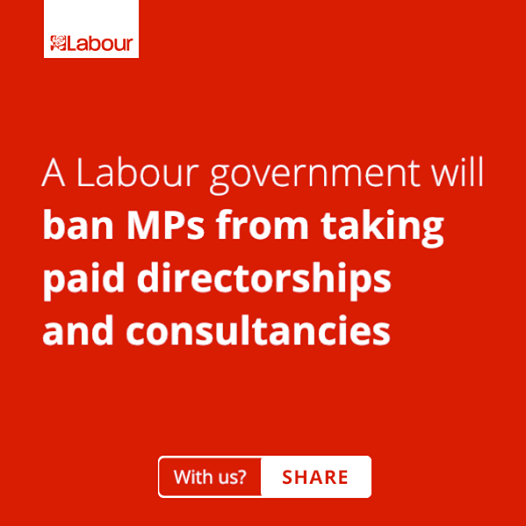
and then asked me to share this image on Facebook:

Labour's disapproved jobs list

Now, I don’t know about you, but it seems to me that there’s a big difference between banning all second jobs, and banning paid directorships and consultancies. So, what is it that Ed is actually planning to ban?

Well, I couldn’t find any reference to it on Labour’s own website, but the Commons has just defeated an attempt by Labour to ban paid directorships and consultancies, so I think we can assume that the infographic, rather than Ed’s original comment, is canonical.

But then, why only paid directorships and consultancies? Why not all second jobs, and why start by giving the impression that it is all second jobs?

Well, the answer is actually fairly obvious. And not in the slightest bit surprising.

If you look at the current list of Members’ Interests on the Commons website, those who have paid directorships and/or consultancies are overwhelmingly likely to be Conservative MPs. Not that the Tories are more likely to have outside sources of income than Labour or the Lib Dems, it’s just that they’re more likely to earn it as directors or consultants. Unlike, for example, Shadow Education Secretary Tristram Hunt, who is a university lecturer. Or former PM Gordon Brown, who has an intriguingly titled role as “Distinguished Global Leader in Residence at New York University”. Or the whole host of Labour MPs who are sponsored by unions.

The simple fact is that Ed Miliband doesn’t want to ban MPs from having second jobs. He just wants to ban them from having the type of jobs more likely to be done by Conservatives, while permitting those done by Labour MPs.

Apart from the sheer hypocrisy and self-serving nature of this, it also means that when Ed says

It’s time to stop MPs taking second jobs once and for all. Your MP should be working solely in the interests of you and your community.

he’s engaging in what, in parliamentary terms, is referred to as being economical with the truth. Or, to you and me, a lie. It’s as simple as that.


[1] He didn’t just send it to me, of course. But it did have my name in it, so I’m entitled to consider it addressed to me.

18 February 2015
by mark
0 comments

Does quality journalism have a future?

I don’t normally read the Daily Telegraph in print, except when I’m visiting my parents and I try to do the crossword before my mum gets a chance. But I’ve been reading it a lot more online recently, ever since it became the best UK-based news website.

It used to be the second best, until the Guardian’s recent redesign elevated style over substance and overtly prioritised advertising revenue over the user experience. Of the others, The Times is good on paper but only has a half-decent website, which is about half what it should be given that you have to pay to view it, and the Independent is execrable in almost every department. I don’t generally read the tabloids either in print or online, except when I’m waiting to collect a takeaway when I sometimes thumb through the copy of The Sun on the table. Mail Online (which is effectively a different entity to the print Daily Mail) has the occasional good item of photojournalism, but otherwise is mostly celebrity gossip and populist rabble rousing.

Which is why Peter Oborne’s resignation from the Telegraph matters. I don’t read his columns often enough to have formed an opinion on his opinions, so to speak, but his account of the Telegraph’s decline is compelling.

Oborne’s decision to jump ship was prompted primarily by the newspaper’s willingness to allow editorial content to be influenced by advertisers. That in turn was highlighted by their reluctance to run articles critical of HSBC, but it seems to have been an issue for far longer than that.

I’m not going to rehash the specific issues raised by Oborne regarding the Telegraph. You can read them yourselves in his own article. What concerns me more is that the Telegraph is not unique.

When the phone hacking scandal broke a few years ago, there was a lot of schadenfreude and barely disguised gloating (and, in many cases, entirely undisguised gloating) among those who were predisposed to hate anything and everything related to Rupert Murdoch. The closure of the News of the World was, for them, vindication. But, of course, we now know (and I rightly predicted at the time) that it was by no means confined to the NotW, or the Murdoch stable. Other newspapers were not just at it as well, but at it on a far larger scale.

So what if the flaws Oborne has identified in the Telegraph are replicated elsewhere? We’ve already seen how aspects of the Guardian’s redesign were prompted by a desire to increase advertising revenue rather than improve the usability of the website for readers. The Independent long ago ceased to live up to its name in any meaningful sense. Oddly enough, the principle of separating editorial from advertiser influence seems to have been strongest under Murdoch. Not that that stops them being extremely non-neutral when it’s their own direct interests are concerned, though.

The problem is, of course, that news gathering and reportage is expensive. It’s understandable that newspaper publishers want to protect and increase their revenue. Whether this means a website built almost entirely around link bait (Mail Online) or giving advertisers control over editorial (Daily Telegraph), we’re likely to see more of it. The BBC, due to the unique way in which it is funded™, is broadly insulated from such concerns, but unfortunately its online news coverage is very shallow by comparison with the quality newspapers (or even, for that matter, the tabloids).

By contrast, some of the fastest growing “news” websites (and I’m putting the word in quotes deliberately) are those which indiscriminately mix news with either entertainment or propaganda (or sometimes both). The likes of Upworthy, Buzzfeed, RT and PressTV are a major threat to the principle of independent, honest journalism, because their success shows that readers – or, at least, their readers, have no great care for it.

So are we seeing the slow death of quality journalism? Maybe. And in a day when every man and his dog can publish their thoughts to the world via a blog (yeah, I get the irony, thanks), and social media breaks news quicker than the rolling TV channels, it could be argued that we don’t really need it. But there’s still a big difference between opinion and fact. And the fact is, whatever a newspaper’s bias when it comes to opinions, we need to be able to trust them with the facts. If we can’t do that, then we do have a real problem.

20 January 2015
by mark
1 Comment

Judge David Cameron on his record

The Huffington Post published a graphic attacking David Cameron which has become something of an Internet meme.

So, let’s look at what Cameron’s record actually is on the things it mentions…

“One million people using food banks” – because the law has changed to make them easier to run, easier to supply and easier to advertise. Presumably people complaining about this would prefer the food banks not to exist, and their customers to go without.

“Largest A&E department closure in NHS history” – because the current medical consensus is that concentrating A&E provision into fewer, but larger and better-equipped, units creates a significantly better overall outcome for patients. This is evidence-led policy, even though it may be counter-intuitive (and that’s precisely when it’s important to follow the evidence instead of public opinion). Incidentally, not that the moaning minnies will have stopped to think about it, this is simply a continuation of policy set by the previous Labour administration.

“Hundreds of thousands of new insecure and zero hours jobs created” – along with hundreds of thousands of new full time and secure jobs. More jobs means more jobs of all kinds. And any job is better than no job.

“Bankers’ bonuses protected” – or, to be more accurate, government not interfering in commercial contracts of employment.

“Debt higher than under Labour” – which would have been the case under the current administration, whatever its colour. David Cameron never promised to reduce the debt over the lifetime of this parliament, merely to reduce the deficit. Which is under way.

“Botched Royal Mail sell-off cost taxpayers £1bn” – OK, I’ll give you that one. Although that was overseen by Vince Cable, of course.

“3.6 million disabled people targeted by spending cuts” – is simply a false statement. There has been no such targeting.

“Introduction of the bedroom tax” – which, of course, doesn’t really exist as there is no such tax. And I personally support the real policy of reducing the cost of social housing by only paying for the space that people actually need.

“Midwives strike for the first time in 133 years” – which is a good argument for banning strikes in essential health-related services.

“£3bn tax cut for the top one percent of earners” – along with £billions of tax cuts for everyone else.

“3.5 million children living in poverty – and expected to rise” – a figure defined in relation to median earnings, so it actually increases as the median salary rises. Which is one of the daft things about using relative measurements of poverty.

So yes, I’m happy to judge David Cameron on his record.

9 November 2014
by mark
0 comments

Putting it into perspective

Remembering the fallen

Remembering the fallen

They shall grow not old, as we that are left grow old:
Age shall not weary them, nor the years condemn.
At the going down of the sun and in the morning
We will remember them.

It felt ever so slightly strange at the Remembrance Day service this morning. Remembrance Day is timed to coincide with the end of the First World War, being the closest Sunday to Armistice Day, the actual anniversary of the end.

This year, though, we’ve been focussing more on the start of the war, given that 2014 marks the centenary of its outbreak. A hundred years ago today, we were still in the early phase of the war and there was still a lot of optimism that it would be “all over by Christmas”. There had, of course, already been casualties, but the sheer grinding horror of the war had yet to become apparent.

But there’s a tendency even now, though, to underestimate how bad the war was. We’re used to modern military campaigns, where even a single death makes media headlines. It’s hard to comprehend the scale of a conflict where so many people died.

So, let’s see if we can put it into perspective. The Afghanistan conflict has been the most deadly of any war zone that British forces have been involved in over the past 40 years, resulting in a total of 453 British military lives lost. That’s more than Iraq (179 British military deaths) or the Falklands (255). The precise number of British military deaths in WW1 isn’t known, but even taking a low-end estimate the number of deaths was around 750,000. That’s an average of more than 500 deaths per day – more than the entire number lost in Afghanistan over a period of thirteen years.

Another way of looking at it is to consider the proportion of Britain’s population lost in the war. The overwhelming majority of military casualties were of young adult men aged from 18 to 35. There were around 6 million men of that age group in the UK at the start of the war. More than ten percent of that age group were lost.

Here’s a way to visualise that. Think of all the men you know personally who fall into that age group. Brothers, sons, fathers, husbands, boyfriends, uncles, nephews, friends, colleagues. Restrict it to people you would say that you actually know, not just acquaintances or social media friends. The sort of people whose funeral you would attend if they were run over in the street tomorrow.

Got that in your head? OK, now imagine that over the next four years, one in ten of them will be killed. Maybe one in fifteen if you’re lucky. Maybe one in five if you’re not.

That’s a lot. The chances are that at least one of your family will be among the casualties. There’s a strong probability that one of the people closest to you will not survive the next four years. It’s almost certain that several of your friends and colleagues will be dead. If you’re male, and you fall into that age group yourself, you may well be dead too.

Think of that, when you next wear a poppy in remembrance of those who died.

2 November 2014
by mark
0 comments

No, Ed, we still don’t need English Regions.

Regional devolution is back in the news following the Scottish referendum. The latest proposal to give more power to the regions comes from Ed Miliband, who wants to replace the House of Lords with an elected senate representing the “regions and nations” of the United Kingdom.

No, Ed, I don't agree.

No, Ed, I don’t agree.

I think this is just as daft an idea as the unlamented Regional Assemblies set up by former deputy PM John Prescott. While regions may make for convenient chunks of a map, or weather forecasts, or even a handy way of subdividing statistics, they are no basis for government administrative boundaries.

I live in Evesham, a traditional market town in Worcestershire. For statistical purposes, Worcestershire is part of the West Midlands, which has some value (though not a lot). We also get regional TV for the West Midlands. But we are not, in any meaningful sense, part of a West Midlands identity. My rural market town has nothing more in common with Birmingham – our putative regional capital – than it does with Leeds, Manchester, Liverpool or London.

A regional assembly, or a senate constituency, for the West Midlands would simply mean subsuming our county identity – which is predominately a rural and market town identity, plus the historic cathedral city of Worcester itself – into one dominated by the metropolitan concerns of Birmingham, Coventry, Wolverhampton, Dudley, etc.

I live in the southern end of the West Midlands. There are parts of Herefordshire which go further south, but not by a lot. Coincidentally, before I moved here, I lived right at the north of the West Midlands, in Stoke-on-Trent. And, trust me, there is very little that Stoke-on-Trent and Evesham have in common, other than needing to go through Birmingham in order to get from one to the other. Oh, and Birmingham Airport is convenient for both. But the one thing we definitely do have in common is that neither of us has any more in common with Birmingham than we do with each other. The idea that Birmingham is somehow a natural or historic capital of the West Midlands, in the way that London is the capital of England, or Worcester is the capital of Worcestershire, is simply laughable.

I don’t think it’s coincidence that most of the proposals for regional government come from the large metropolitan areas. For people in, say, Birmingham (or Manchester, or Newcastle), regional assemblies are a way for them to not only get a bit more freedom from London-based politics for themselves but also to be able to lord it over their suburban and rural hinterlands as well as second tier cities nearby. Those of us in the rural areas or smaller cities don’t gain anything. Instead, we simply have another layer of bureaucracy in between us and Westminster.

Letting the big cities have more power for themselves, London-style, arguably makes sense. But giving the big cities more power over their neighbouring counties does not. And that applies both to old-style Regional Assemblies as proposed by John Prescott and Ed Miliband’s new “Senate for the Regions”.

If we’re going to have a reformed House of Lords, then let’s do it properly and not create a metropolitan oligarchy which takes no account of genuinely local democracy. Instead of creating yet another layer of local government, let’s give more power to the layers we already have.

27 October 2014
by mark
0 comments

Noel Wilkes, a true Evesham hero

On the way to Tesco on Saturday evening, I passed what appeared to be the immediate aftermath of a road accident just outside St Ecgwins Club in Evesham High Street. A man was lying in the road, being attended to by passers-by. I briefly considered stopping, but made a decision not to as there were already several people present, and I don’t have any in-depth first aid training, so I’d have simply been adding to the numbers for no good purpose. So I drove on. By the time I made the return journey, the road had been closed off by the police and I had to take a diversion to get home.

So it wasn’t until today that I learned two things: The accident had proven fatal and the victim was Noel Wilkes.

Noel was a veteran of the D-Day landings and, even at the age of 90, an active member of the Evesham Royal British Legion. I can’t claim to have known Noel well, but during my time as Mayor of Evesham last year I had the pleasure of his company at several events organised by the Legion. And it was a genuine pleasure; Noel’s enthusiasm for his task was obvious and, despite the impressive array of medals he was entitled to wear at ceremonial occasions he wore his history lightly. He never boasted of his achievements, but was always willing to answer questions and share his knowledge. Noel was one of that rare breed of men: a genuine hero of war who lived up to that label in peacetime. Until the very last day of his life he was dedicated to serving his community.

Noel Wilkes

My thoughts, prayers and sympathies go out to Noel’s family. Losing a man of his stature is always a tragedy. To lose him in such a manner is doubly so.

RIP Noel Wilkes. You truly fought the good fight.

21 October 2014
by mark
4 Comments

Auf Wiedersehen, Ukip

Economic migrants leaving their homes in a poorer country to find work in a richer one.

If, like me, your musical memories consist of the likes of Duran Duran, Blondie, The Human League, The Sex Pistols and Bon Jovi, then you’ll probably also recognise my opening paragraph as the backstory for the hugely popular 1980s ITV comedy, Auf Wiedersehen, Pet. For those who don’t remember the series, here’s Wikipedia’s summary of the plot:

The first series, co-produced by Witzend Productions and Central Television for ITV in 1983, is the story of seven out-of-work construction workers from various parts of England who are forced to look for work in West Germany, although it focuses initially on three men from Newcastle upon Tyne making the journey to Germany, with the others being introduced along the way. (The title refers to their farewells to their wives and girlfriends – “Auf Wiedersehen” being German for “Farewell” or “Goodbye”, and “Pet” being a North-East English term of endearment).

Back in the early 80s, it wasn’t at all uncommon for British construction workers to look for work elsewhere. In 1983, the year that Auf Wiedersehen, Pet was first broadcast, unemployment had hit a record high. The late 70s had left the UK as the “sick man of Europe”, with strikes destroying industries and the economy in tatters. The Winter of Discontent in 1978-79 proved the nail in the coffin as far as Jim Callaghan’s Labour government was concerned, and in May of that year Margaret Thatcher swept to power. Four years later, in 1983, a snap election saw Thatcher’s Conservative party retain power with a landslide victory over a demoralised and bitterly divided Labour.

Despite her electoral achievements, though, Thatcher’s government had yet to achieve the economic success that was later to be the hallmark of her administration. Unemployment continued to rise throughout her first term, and it wasn’t until Arthur Scargill’s disastrous attempt to use the NUM against her in 1984 that the power of the unions was finally broken. In 1983, things still looked pretty bleak. And, for the ordinary working man, there was a double whammy: the effing Tories in power and no jobs to go to. Putting up with a government you didn’t vote for is a lot easier when you’re still doing OK on a personal level. But many in the traditional heavy industries were a long way from that.

Auf Wiedersehen, Pet drew on that background. As, too, did other seminal drama series of the time, such as Boys from the Blackstuff. Although nominally a comedy, Pet was rooted in the same realistic backdrop of poverty and unemployment in the North of England.

Germany, by contrast, was doing pretty well in 1983. Inflation was among the lowest in Europe, unemployment was also low, and the German economy was growing steadily. The construction industry, always very sensitive to the overall economic health of a country, was doing well there too. Britain’s economy was actually growing faster than Germany’s at the time, but from a much lower base. We had a long way to go to catch up.

It wasn’t surprising, therefore, that many British construction workers followed the path depicted in Pet. Germany offered plenty of work, and paid higher wages. To be sure, it also meant leaving your comfort zone and living – often in cheap and crowded accommodation – far from home in a place with a different language, different money and different food. But for those willing to make the move, it was worth it.

Fast forward three decades, and we’re still seeing a large number of people from a poorer country leaving home to look for work in a richer one. The difference is that this time, it isn’t Brits moving to Germany, it’s Eastern Europeans moving to Britain. But if you disregard the nationalities, what’s underneath is remarkably similar.

Just as in the early 1980s, what we have in the 2010s is a rich and financially successful country – the UK now, Germany back then – proving a magnet to jobseekers from countries that are much further behind on the economic growth path.. For 1980s Britain, read 21st century Poland, Lithuania and Romania. We have become the destination, and not the point of departure.

Yes, it’s true that we’ve had a tough few years here as well, following the global crash at the end of the previous decade. But we’ve also weathered the storm more successfully than many other countries. The UK is now one of the most vigorous economies in Europe. Unemployment and inflation remain low, despite the downturn. According to Dan Hannan MEP, writing in the Daily Mail, we have created more jobs over the past four years than the other 27 members of the EU put together. So it isn’t surprising that the UK is an attractive source of work for people from other parts of the continent. They’re coming here because we have been so successful.

This is the point that the anti-immigration complainers are missing. The reason why we have an immigration “problem” is because we don’t have an economic problem. Even with the late-noughties recession, we’re still light years ahead, metaphorically speaking, of where we were in the early 80s.

Love her or hate her, Margaret Thatcher’s economic legacy was indisputably a success. So – let’s not be partisan about this – was Tony Blair’s. It’s arguable that the wheels came off under Gordon Brown, but to be fair that wasn’t entirely his fault. And, unlike the long drawn out car crash of the Wilson/Callaghan years in the 70s which in turn took over a decade to untangle, the downturn under Brown has been swiftly reversed under David Cameron’s coalition government. We’re already back to within touching distance of the 2008 peak.

The simple fact is that immigration and economic prosperity go together. Every successful economy has net immigration. In particular, every successful economy has net inward economic migration – the kind of temporary migration that saw Geordies working in Düsseldorf in the early 1980s and sees Poles working in Evesham in 2014.

So how do we fix the immigration problem? It’s simple, really. We turn the clock back to the days when nobody wanted to come here, but our workers wanted to go elsewhere. We create mass unemployment so that there are no jobs for the immigrants to take. We screw up the economy so that other countries are richer than ours. We promote rampant inflation so that our money becomes worthless. And we watch the economic migrants – our own as well as those from other countries – go elsewhere while Britain gets left behind. Never mind Ukip Calypso, this is what we’ll all be singing if Nigel Farage gets his way:

Of course, we all know that things did eventually get better after The Specials released that single in 1981. In the long run, it was Thatcherism that rescued Britain rather than destroyed it. But we had to go through some pretty dark days to reach the sunshine. Those are the days that Ukip would take us back to if they could.

Fortunately, there is another way. Instead of harking back to some fondly-imagined (but badly remembered) past, we can continue to build on what we’ve achieved over the past four years. It’s time to say Auf Wiedersehen, Ukip.

16 October 2014
by mark
2 Comments

A brief history of local government in Evesham

When considering Evesham’s history, the things that come to mind tend to be the obvious ones: the founding of the Abbey as a result of Eof’s vision, the battle of Evesham, the ongoing dispute between the Abbey town of Evesham and the castle town of Bengeworth (which the Abbey won), and finally the destruction of the the Abbey leaving us with just the Bell Tower standing. But I thought it might be interesting (to fellow politics nerds, anyway) to look at some more recent history and trace how Evesham came to have its current form of local government.

Local government as we know it in Evesham started in 1605 when the town was granted a Royal charter by James I. Town charters were by no means new – the very first was granted to the City of London in 1075 – but they were only granted as and when the townsfolk could persuade the king to grant one, and it wasn’t until 1605 that Evesham got theirs.

Records show that Evesham’s Royal charter was granted on the request of Prince Henry, James I’s eldest son and heir to the throne. The young prince in turn appears to have been influenced by his chaplain, the Reverend Dr Lewis Baylie, who happened to be combining his royal duties with serving as the vicar of Evesham at the time.

Henry never lived to ascend to the throne, dying of typhoid fever at the age of 18 in 1612. But his name lives on not only in the town’s charter (and his emblems on the town’s coat of arms) but also in one of Evesham’s most distinguished institutions. The charter also formally united the neighbouring towns of Evesham and Bengeworth as a single government entity, and thus marked the end of Bengeworth’s independent existence.

Grant of joint incorporation of the towns of Evesham and Bengworth, under the name of the Mayor, &c., of the borough of Evesham; with confirmation of their former liberties, and grant of new ones, including license to have a schools called “The Free Grammar School of Prince Henry.”

As well as subsuming Bengeworth into Evesham and giving one of the region’s most prestigious schools its name, the charter created a town council comprising several aldermen and headed by a mayor. The council was exempt from certain levies paid to the king, and had the right to raise its own taxes and operate a market (the charter market, of which today’s market is the direct descendant).

That gave Evesham, for the first time, a measure of control over its own finances, with income from taxation and the market available for the council to spend as it saw fit. The first Mayor of Evesham was Robert Allen, of which we know little other than the fact that he was a “Gentleman”, that is, a member of the upper classes and a landowner.

In fact, the majority of Evesham’s early mayors were Gentlemen, interspersed with the occasional Esquire (in social terms, ranking slightly above a Gentleman), a few Reverends and even a Baronet – it wasn’t until 1762 that the first occupational title appeared on the name boards, and not until 1836 when occupational titles became predominant.

These early members of the town council were not elected. The very first members were appointed by the charter, and subsequently appointed their own successors when necessary to fill a vacancy left by retirement or death. So, although Evesham had a certain amount of self-governance, it was not democratic self-governance. For more than two centuries, Evesham was governed by a self-perpetuating clique consisting predominantly of the upper classes with a smattering of clergy and wealthier tradesmen. The thing which changed that was the Municipal Corporations Act 1835.

Following on from the Representation of the People 1832 (better known as the Great Reform Act), which had abolished the “Rotten Boroughs” in the process of taking “effectual measures for correcting diverse abuses that have long prevailed in the choice of members to serve in the Commons House of Parliament”, the Municipal Corporations Act aimed to do the same to local government.

178 town or borough councils were reformed immediately by the Municipal Corporations Act, and another hundred followed over subsequent years. Evesham was one of the initial 178. The changes brought in by the Act were far-reaching and created a body which, for the first time, would be clearly recognisable as the predecessor of that in which I serve today.

The newly-reformed municipal boroughs, or corporations, were obliged to publish their accounts, and were subject, for the first time, to external audit. They also had to employ a salaried town clerk and treasurer, who could not be a member of the council. But the most significant change was that all members were now elected, representing a system of local wards which also still persists to this day.

As you might expect, this significantly changed the composition of the council. Previously, the mayoral name boards had been overwhelmingly dominated by members of the upper classes. From 1836, occupational titles started to become more common. By the late Victorian era, Gentlemen and Esquires had become as rare as non-gentry had been earlier. The last member of the gentry to appear on the boards was Henry Smith Esq in 1904. And Evesham’s first female Mayor, Amy Nightingale, held the office in 1944.

Following the Municipal Corporations Act, the Victorians would continue tinkering with local government until the turn of the century. Most of what we now consider “traditional” local government was, in reality, a Victorian (or immediately pre-Victorian) invention. But this was predominantly at county and city level, market towns such as Evesham avoided further reform until well into the 20th century.

The Representation of the People Act 1948 had a relatively modest effect on Evesham, with the only significant change being the timing of elections – these were switched to the now-familiar first week in May. Other post-war legislation was, again, concentrated on county level and left Evesham unscathed. It wasn’t until 1974 that reform again meant changes to the town.

The Local Government Act 1972 was certainly the biggest change to local government in England since the Municipal Corporations Act 1835, and arguably the biggest ever. Whereas previous reforms had addressed the composition and constitution of local government, the Local Government Act reformed its boundaries. And some of the new boundaries were radically different from what had gone before.

The legacy of the Victorians was essentially a county-based overall structure, with an ad-hoc system of boroughs, towns, cities and parishes beneath it. Evesham, as a major market town in Worcestershire, had more local autonomy and more power than, for example, Pershore, but less than Worcester. The new legislation aimed to create a uniform two-tier system across the country, with counties at the upper level and districts below them. Both counties and districts would be based on population geography rather than traditional geography. And Evesham, being a medium-sized market town, bigger than a parish but smaller than a city, fell fairly and squarely into the gap.

The outcome was that Evesham, for the first time since 1605, was reduced to the status of a parish. The borders of the new Evesham Town Council were much more tightly drawn than its Borough predecessor, and most of its powers were transferred to the newly created Wychavon District Council.

Fortunately, the Royal charter granted by James I was not rescinded, and remains the charter of the new Evesham Town. We retain our coat of arms, including the crown and the Prince of Wales feathers, as well as the right to operate a market. We still also have limited tax-raising powers, and we still have to employ a town clerk. But, apart from the property we own or manage, we have no direct powers over the administration of the town.

Probably the best illustration of the difference between the powers of Evesham council then and our powers now is to look at our bridges. Workman Bridge, named after the Mayor who oversaw the project, was constructed by the town and funded from within the town. The first Abbey Bridge, opened in 1928, was built by the county and Evesham Corporation working together. The new Abbey Bridge was built by the county without any input from the town, and if we want to as much as put a banner on a lamppost on the new bridge we have to get permission from Wychavon.

It’s all a long way from the height of Evesham’s powers in the late 19th century. But we’re still here to do our best for the town. And there’s plenty of potential still for the future.